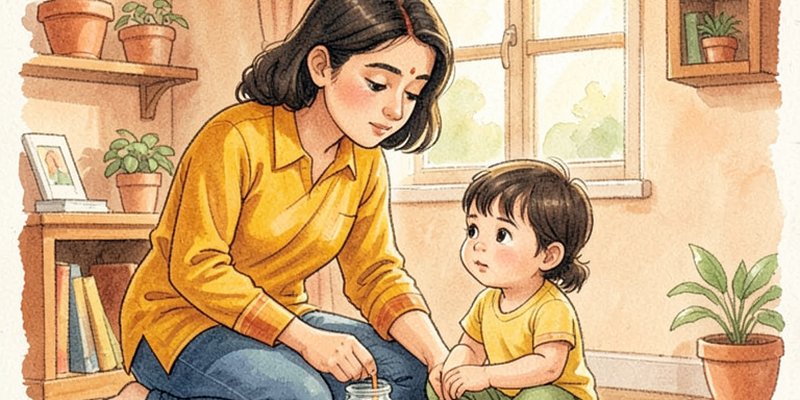
Age 6
You want your child to have values, but you're wary of imposing religion — and you're not sure what's left once you take that out.
What Stays With Them ·12 months ·4 – 14 years
You can't lecture a child into being kind, honest or fair. Values pass down mostly through what a child sees the adults around them do when things get hard. This is a programme on choosing a small number of values deliberately, and closing the gap between what you say and what you do.
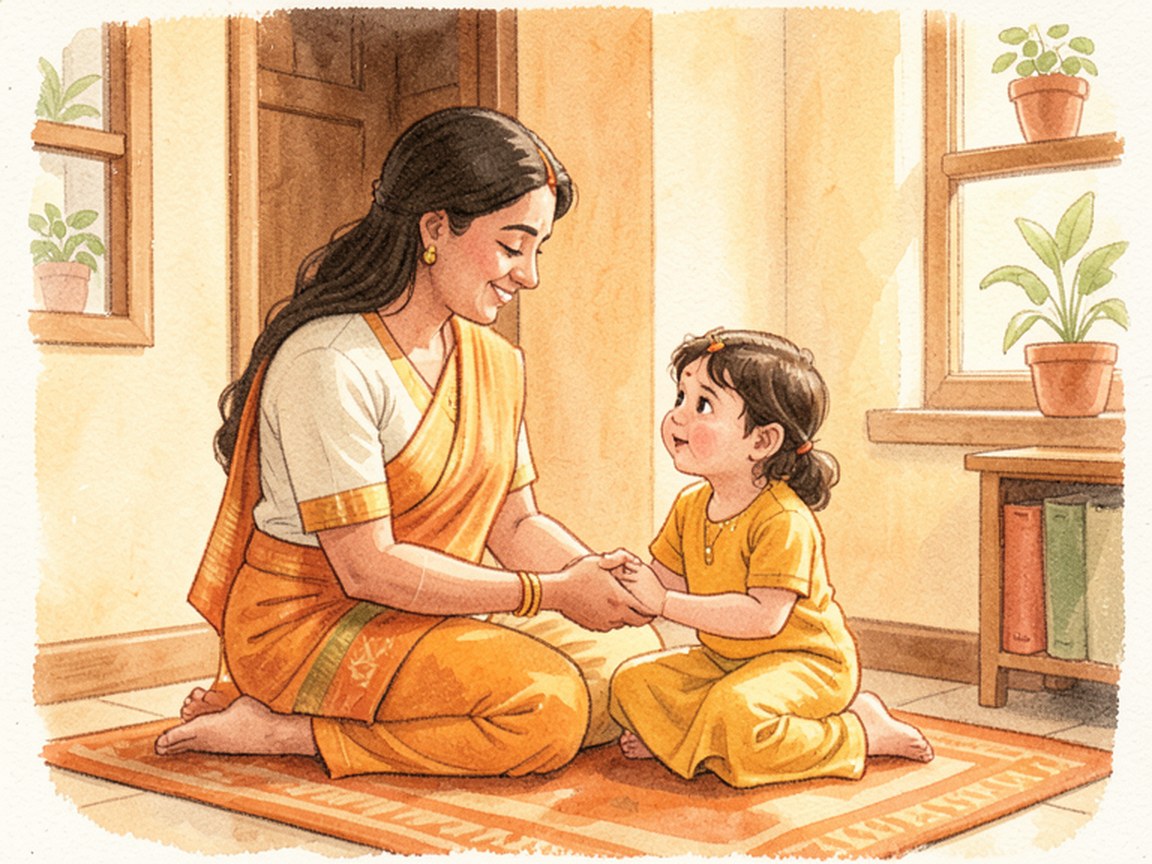
Values transmit mostly through what children watch adults do under pressure, not through what they are told. The practical work for a parent is choosing a small number of values deliberately rather than gesturing at all of them, and then noticing — honestly — the places where your own behaviour contradicts the thing you most want to pass on.
Read this first
One thing worth naming. If what you're carrying is less about your child's values and more about a rupture in your own — a crisis of faith, a grief, a moral injury you're still metabolising — that deserves its own space, with someone qualified to hold it, rather than being worked out through your parenting. The two are related, but they aren't the same conversation, and you shouldn't have to have them at the same time.
How this changes as they grow.
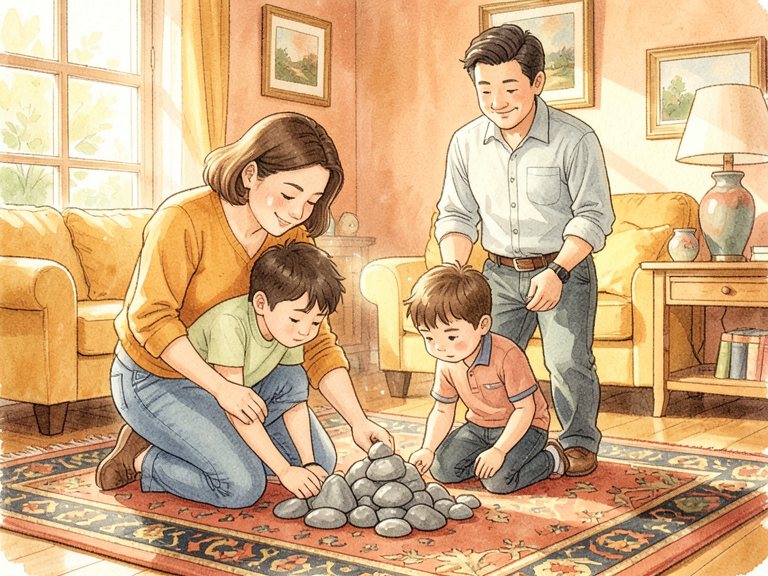
Age 6
You want your child to have values, but you're wary of imposing religion — and you're not sure what's left once you take that out.
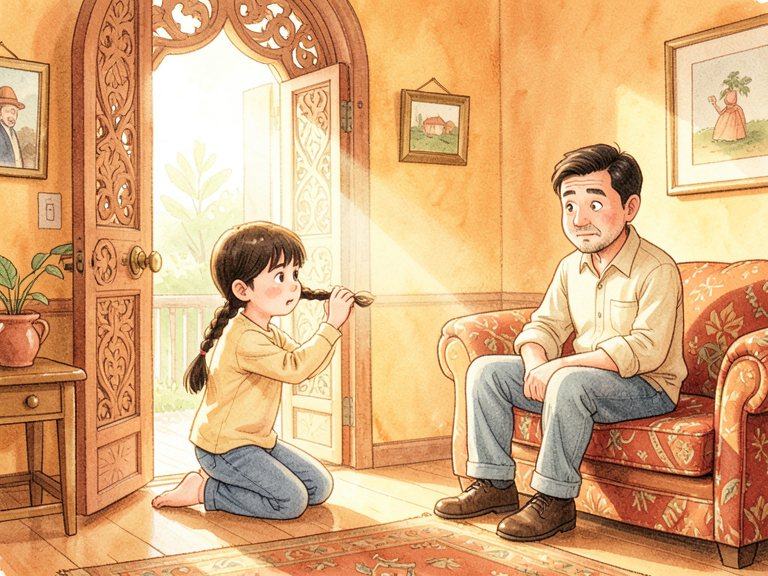
Age 9
Your child is warm and kind at home, and something quite different the moment they're outside it.
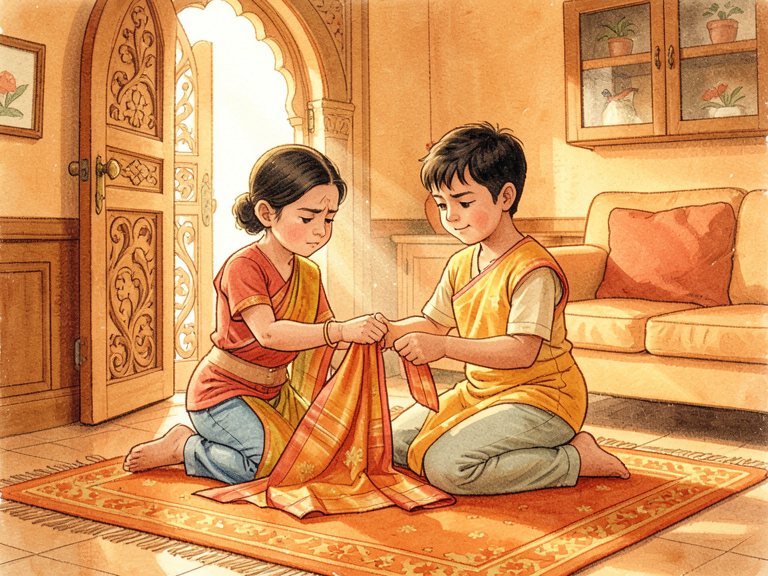
Age 12
You hear yourself say one thing and, an hour later, do the opposite in front of them.
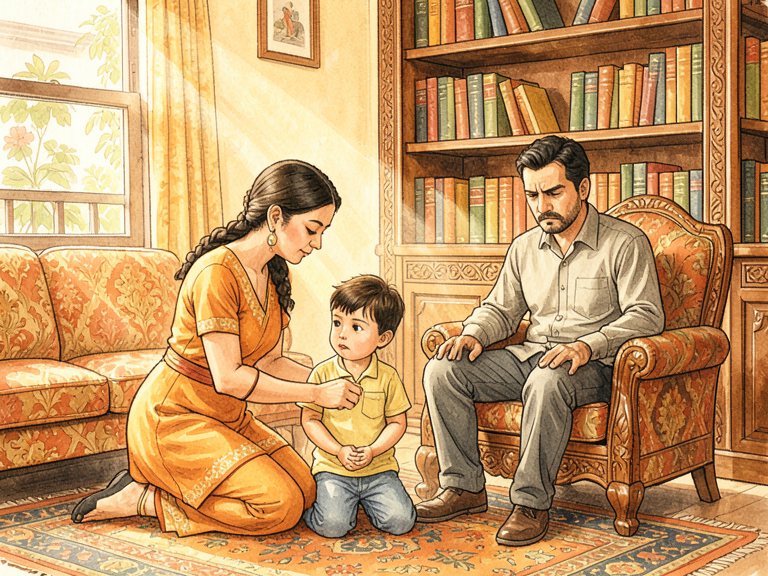
Age 14
A relative is teaching your child something you disagree with, and you don't know how to counter it without a fight.
Age 16
You want to answer the hard questions — about fairness, death, God, honesty — and you freeze, because you're not certain what you believe.
Now
You have a long list of things you'd like your child to be, and no sense of where to actually begin.
Swipe through the day
There is a particular disappointment most parents know. You sit your child down, you explain — clearly, patiently — why honesty matters, or kindness, or why we don't take what isn't ours. They nod. They may even repeat it back. And then, an hour or a day later, they do the opposite, as though the conversation never happened.
It is tempting to read this as a failure of the lesson. It is closer to the truth to say the lesson was never the thing doing the teaching.
Children learn values the way they learn a mother tongue: not from formal instruction but from immersion, from thousands of ordinary moments in which they watch how the adults around them actually behave. And crucially, they watch most closely not when you are calm and explaining, but when you are under pressure — tired, provoked, cornered, inconvenienced. That is when your real values show, and that is when your child is taking notes.
This is uncomfortable, because it moves the work from the child to the parent. But it is also freeing. You do not have to become a skilled moral instructor. You have to become someone who lives, most of the time, close to the values they want to pass on.
Ask a parent what values they want their child to have and the list arrives quickly and long: kind, honest, hardworking, respectful, humble, generous, brave, disciplined, grateful.
Every item is worthy. The list, as a list, is useless.
A child cannot absorb a dozen values at once, and neither can you model a dozen well at the same time. What happens instead is that everything gets a little attention and nothing gets enough, and the values stay abstract — words repeated at children rather than qualities built into a household.
The households where this works choose. They pick a small number — often three — and let those become the spine of how the family actually operates. This is not a lowering of ambition. A child who deeply absorbs honesty, kindness and courage has more to build a life on than one who has heard all nine virtues named and lived none of them.
Choosing is harder than it sounds, because it forces you to say what you actually prize most, and to notice which items on your list are truly yours versus inherited by reflex. That narrowing is much of the work, and it is where this programme begins.
Once you have your few values, there is a test they must pass, and it is a demanding one.
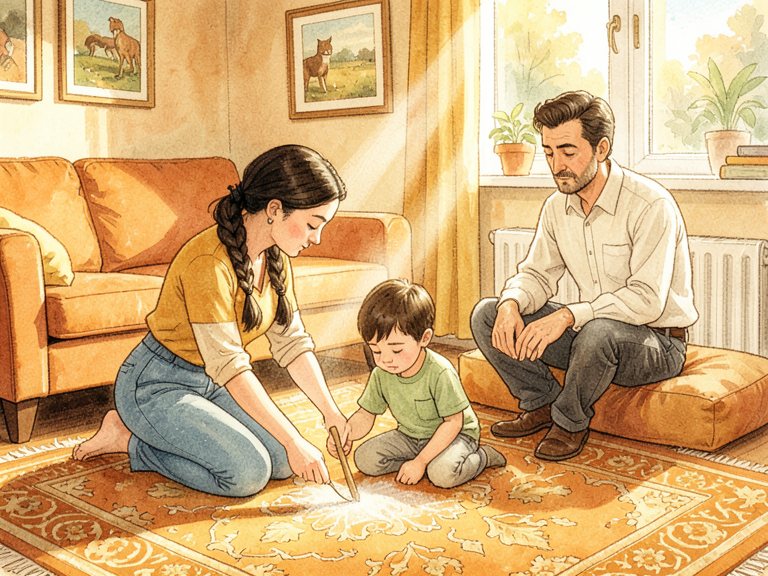
Take a value — say, honesty. Now watch yourself for an ordinary week. The small untruth to get off a phone call. The adjusted story that makes you look better. The instruction to your child to tell a caller you're not home. None of these is a moral catastrophe. Every one of them is a data point your child is quietly collecting.
This is the consistency test: not whether you believe a value, but whether your behaviour under real conditions matches it often enough for a child to learn it as true. The gap between the two — between the stated value and the lived one — is precisely the space where children learn that words and actions are separate things, which is itself a lesson, and not one you meant to teach.
This will not make you a perfect parent, and no programme that promised to make you one would be telling the truth. Every parent contradicts their own values sometimes; children are robust enough to survive that. What matters is the direction and the honesty — whether you are, on the whole, living close to what you profess, and whether you can acknowledge the gap rather than defend it. A child who sees a parent admit "I shouldn't have done that, it wasn't kind" learns more about values than one raised by someone who never slips and never says so.
For many Indian parents, this whole subject sits on top of a more complicated one: their own relationship to religion and tradition.
You may have grown up inside a faith you now hold loosely, or not at all. You may want your child to have the moral grounding you associate with that tradition, without the parts you've set aside — and feel unsure whether the two can be separated. You may have relatives for whom values and religious observance are inseparable, and who are teaching your child accordingly.
There is no single right resolution to this, and the programme doesn't push one. What it offers is a way to work honestly inside the ambiguity. Indian ethical and philosophical thought is unusually rich in exactly this territory — ideas about right action, duty, restraint and compassion that can be drawn on as moral inheritance without requiring you to settle questions of belief you haven't settled yourself. Stories from the epics, everyday rituals, the moral texture of festivals: these can carry values across to a child whether or not you frame them as religious truth.
The aim is not to hand your child your certainties, which you may not have. It is to pass on a moral vocabulary rich enough for them to reason with, and honest enough that it doesn't collapse the first time they ask a question you can't fully answer.
This is slow work, and it is worth being plain about that. Values do not install in a workshop; they settle over the years a child spends watching you, which is why this programme runs across a year rather than a few weeks.
What tends to shift is not the child first, but the parent. You get clearer about what you actually stand for, and narrower — three things you can hold rather than a list you gesture at. You start catching your own contradictions in real time, which changes what your child sees. You find you can answer the hard questions without freezing, and hold your line with a disagreeing relative without turning it into a war. And the stories and small rituals you build stop being decoration and start doing real work, making a value visible in the ordinary run of days.
The child changes too, but on their own timeline and in their own way — usually not as a dramatic before-and-after, more as something you notice in passing, a year on, in how they treat someone who couldn't do anything for them. That is what stays with them. Not the lectures. The thing they watched you be.
Write down the three you would most want a grown version of your child to carry. Not the full list of virtues — the three you'd defend if you could only defend three. The narrowing is the exercise; a child can absorb three lived values, not thirty stated ones.
Take one of your three and look, without flinching, for a moment in an ordinary week where you don't live it — the small lie on a phone call, the impatience with someone serving you, the corner cut. You're not looking to feel guilty. You're locating the exact place the real teaching happens.
The next time your child asks something you find difficult, resist the tidy answer. 'I'm not sure, let me think about it' teaches more about honesty than a confident answer you don't believe. Children can tell the difference.
That helps in the moment. Changing the pattern takes something else.
Twelve months on the quiet, cumulative work of raising a child with a moral centre — because values aren't installed in a workshop, they settle in over the years a child spends watching you.
We start by narrowing. Most parents want their child to be kind, honest, hardworking, respectful, generous, brave and a dozen other things — and a child cannot absorb a list. We work out which few values are genuinely yours rather than inherited by default, what they actually mean in your household, and whether they can stand without requiring a particular religious belief underneath them.
The heart of the work. Values are caught more than taught, and mostly caught in the moments you aren't performing — how you speak to the delivery person, what you do when no one is watching, how you behave when you're tired and provoked. We run each of your three values through a plain consistency test and look honestly at where you fall short, because that gap is where the real curriculum lives.
Values need vehicles. We look at the stories, rituals and everyday practices that carry meaning across generations — including how to draw on Indian ethical and philosophical thought without requiring belief, and how to build small household rituals that make a value visible rather than merely stated.
The year closes on the pressures that test everything: the hard questions children ask about fairness, God and death; relatives who teach things you disagree with; and the gap between the kind child at home and the different one outside it. We work on answering honestly, holding your line without a war, and helping a child carry their values into a world that won't always share them.
Small group — deliberately. Few enough that everyone is known, and no one is a spectator.
Message us to hear about dates, structure and fees for the next cohort.
Purnam is an AI-native parenting companion for modern Indian families. A structured programme, a smart companion that knows your family, and a small, honest community of parents — built to take you from surviving the day to thriving across the years.
Parenting that hasn't been handed down — for the generation that wants to parent differently than they were parented, but has no cultural template for it.
Purnam · our positioning
Purnam is built by a founding team with 18+ years across big tech, startups, and growth-stage technology companies — and, more to the point, by parents currently inside the early-childhood years themselves.
Parents to a toddler ourselves — building Purnam to help Indian families move from surviving to thriving.
Purnam's approach draws on modern developmental psychology — attachment, emotional regulation, behavioural coaching — held alongside Indian contemplative traditions as practical tools rather than belief.
We are advised by senior practitioners in human transformation and behavioural coaching. Where the evidence for something is strong, we say so. Where it is contested, we say that too.
Message us on WhatsApp about What Stays With Them — dates, structure, fees, and whether it fits your situation.
Or just ask your actual question. That's what the line is for. Someone from the Purnam team will get back to you.
Purnam offers parenting support and education. This is not paediatric, medical, or mental-health treatment, and it is not a substitute for care from a qualified professional. Every child and family is different; nothing here is a promise of any particular outcome.