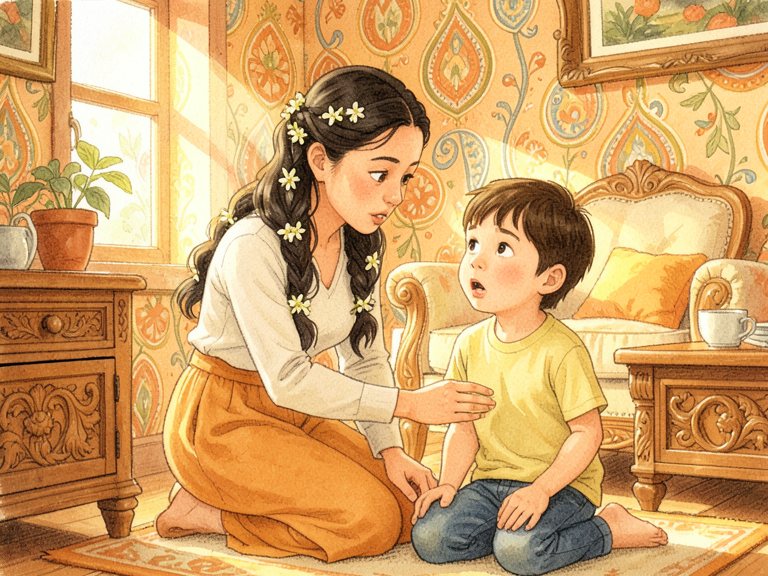
Age 6
Your mother's exact sentence, word for word, in your own voice — and the small shock of hearing it.
Breaking the Cycle ·6 months ·All ages
Hearing your parent's exact sentence come out of your own mouth is not failure. It's the pattern surfacing where you can finally see it. This is a programme on noticing it, building a pause, and choosing what stops with you.
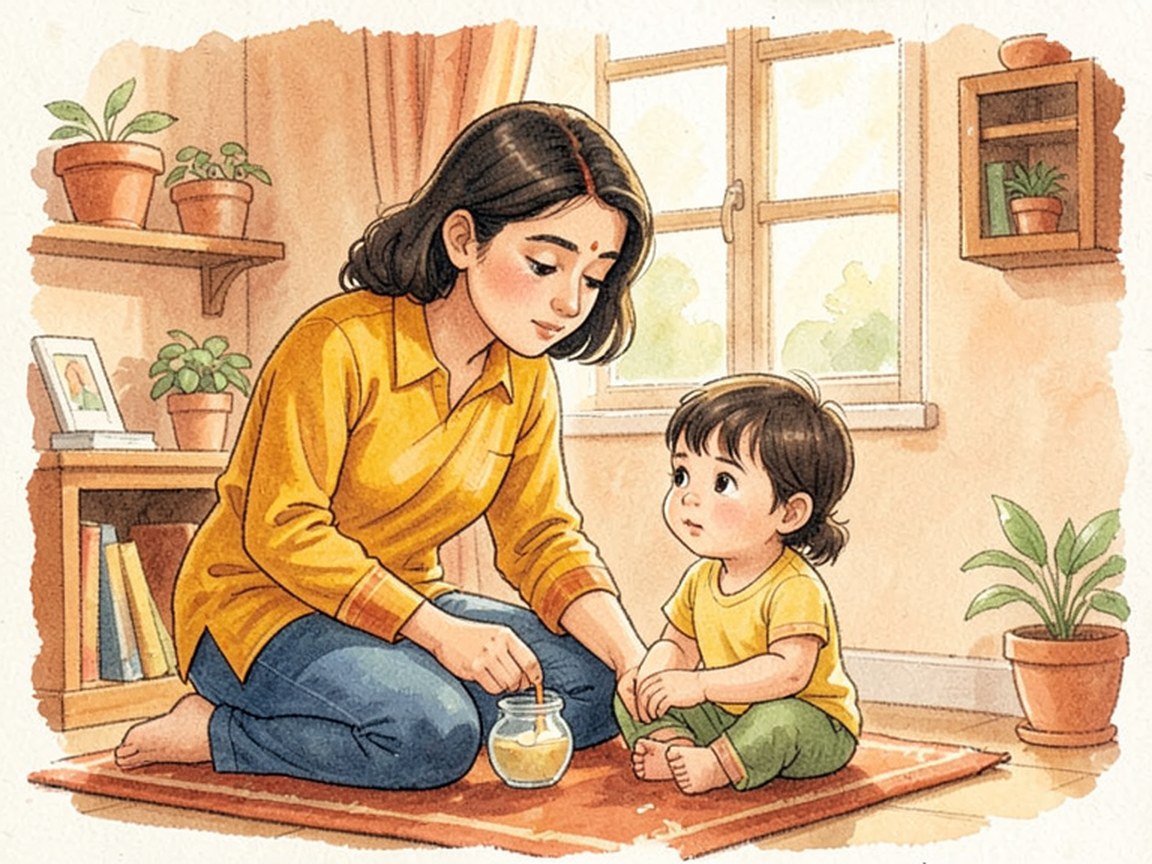
Hearing your parent's voice come out of your mouth isn't failure — it's the pattern surfacing where you can finally see it. Patterns break at the point of noticing, not at the point of deciding. The work is building enough pause between the trigger and your response for a different choice to become available to you.
Read this first
One thing this programme is not. If what you carry from childhood is abuse, or trauma that still surfaces in your body and your sleep, that is not a pattern to notice and adjust over six months — it is real injury, and it deserves real care. Please see a qualified therapist or counsellor; a good one will help in ways this programme is not built to. Seeking that help is not a detour from breaking the cycle. It is often the most direct way through it.
How this changes as they grow.
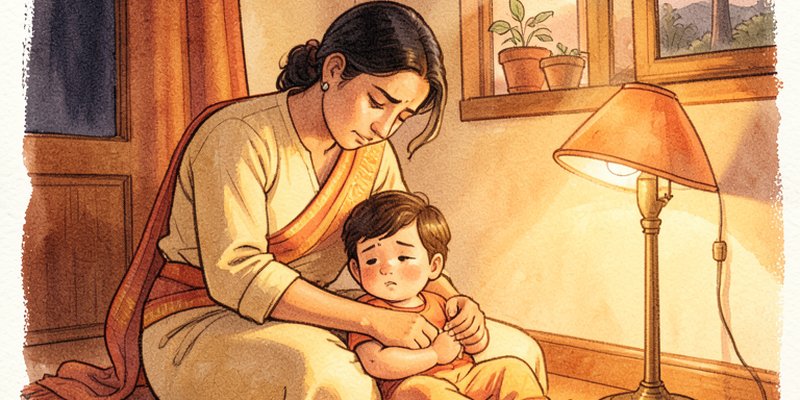
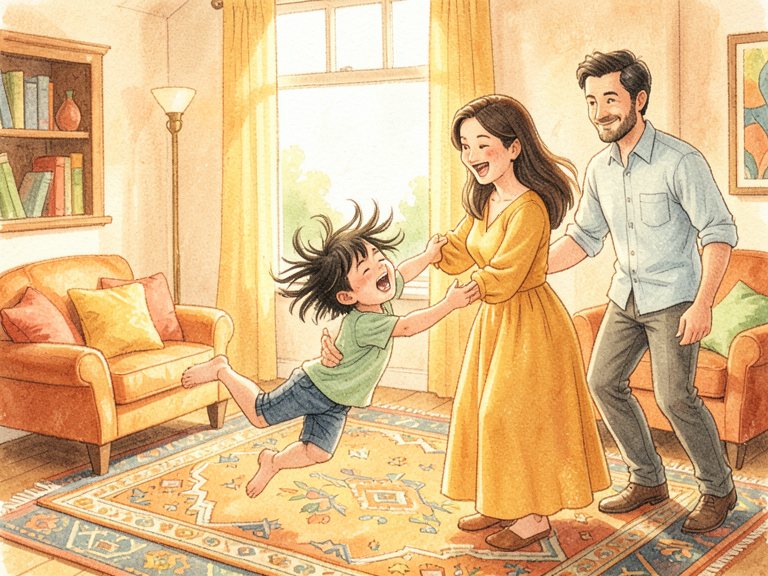
Age 6
Your mother's exact sentence, word for word, in your own voice — and the small shock of hearing it.
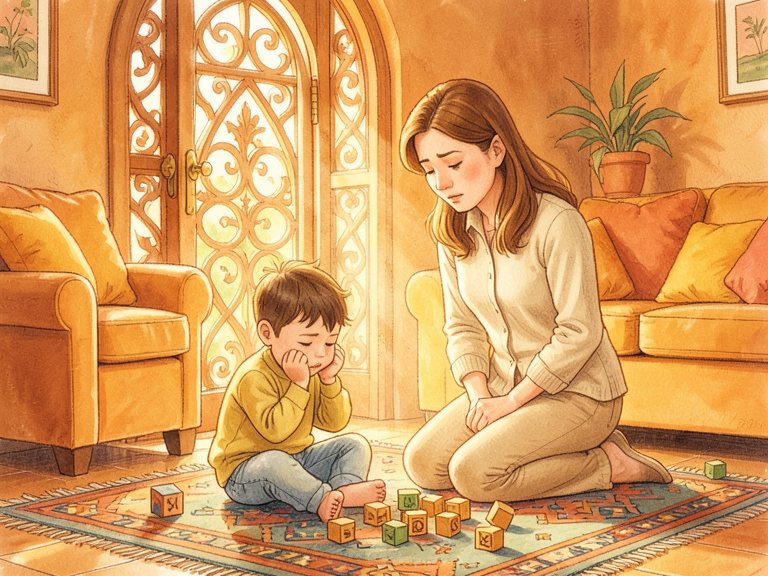
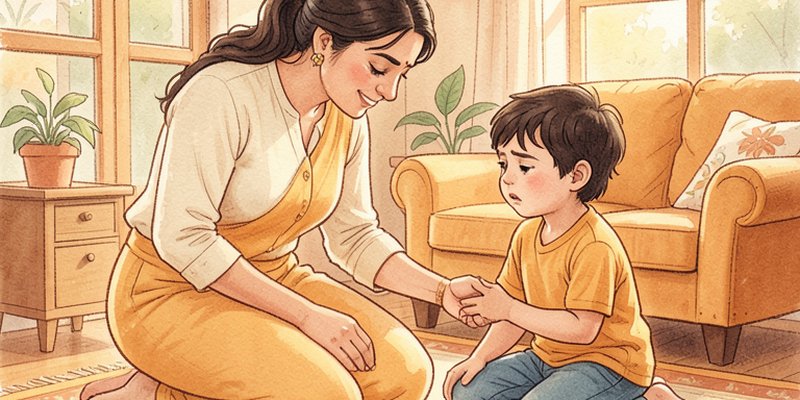
Age 9
Your child cries, and you react the way you were reacted to before you've decided anything.
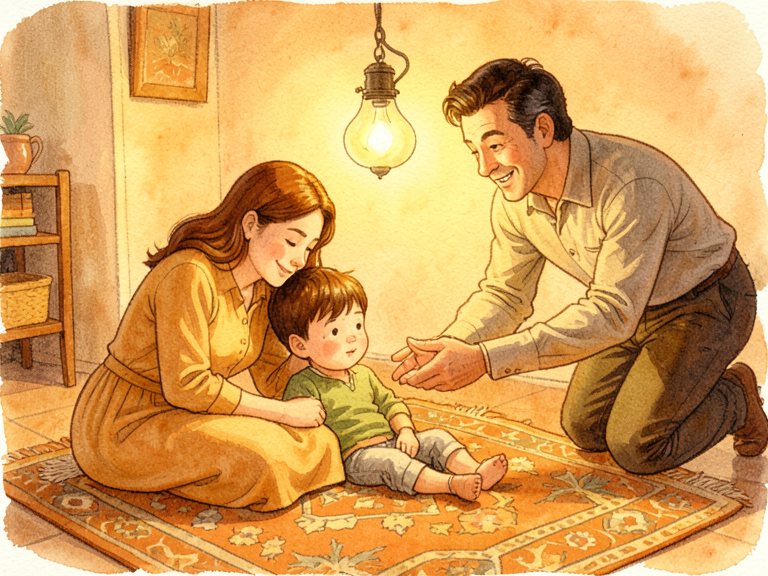
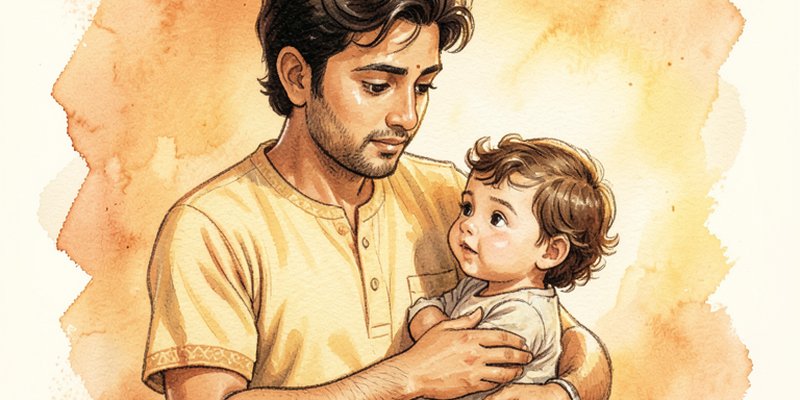
Age 12
You want to offer warmth and realise you're not sure what it looks like, because it wasn't modelled for you.
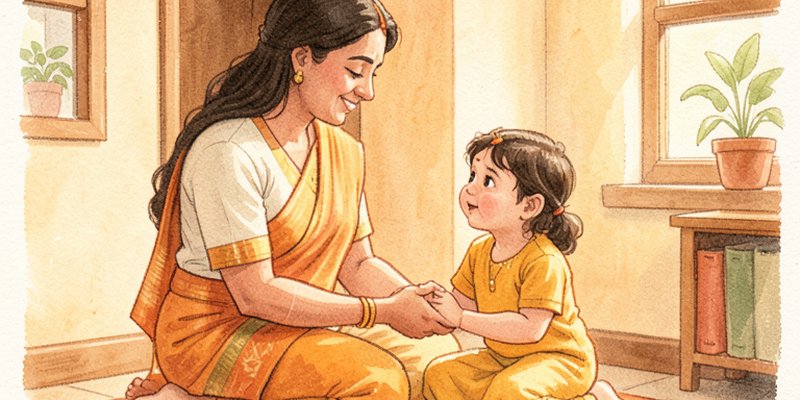
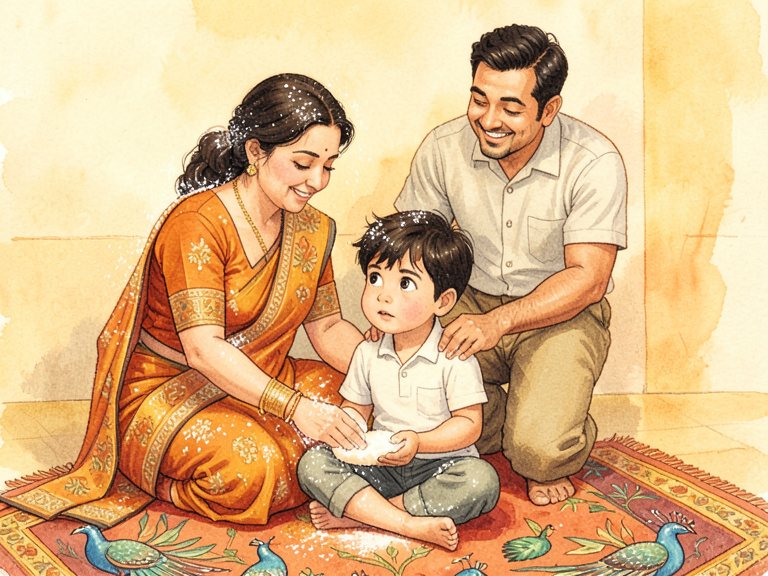
Age 14
You've swung so far the other way that there are no boundaries left at all.
Age 16
Your body tightens a half-second before you understand why.
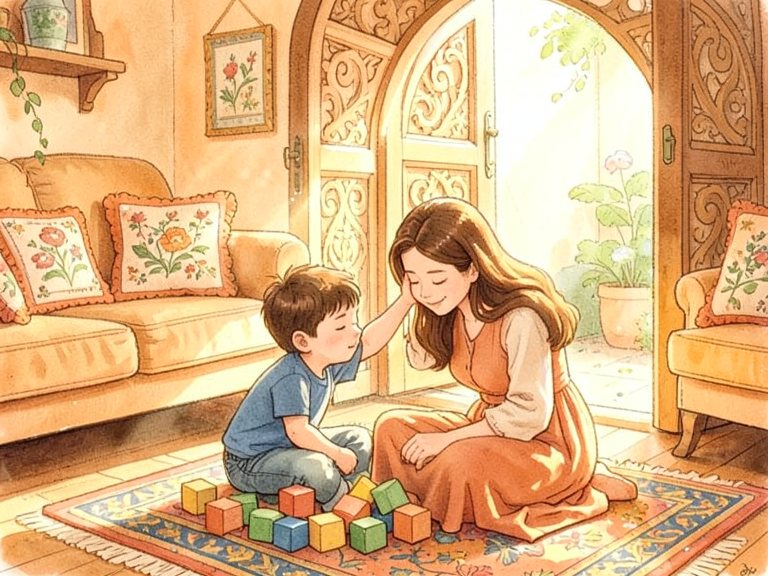
Now
You notice your child has started managing your moods — and you know exactly where they learned it.
Swipe through the day
There is a particular jolt that brings most parents to this work. Your child does something ordinary — cries too long, answers back, spills the milk a second time — and out of your mouth comes a sentence. Not a sentence you chose. Your mother's sentence, or your father's, in their cadence, with their heat behind it. You hear it land and you think: I swore I would never say that.
That jolt is not a sign that you have failed. It is the opposite. For years the pattern ran underground, in a house you no longer live in, on a child who no longer exists. The moment it surfaces in your own voice is the first moment you can actually see it — and a pattern you can see is a pattern you can finally do something about. Most people never get this far. They repeat what they were given without ever noticing it was given.
So the discomfort you're feeling is not the problem. It is the beginning of the solution. The work of this programme starts exactly here: not with resolve, not with a promise to do better, but with learning to notice.
It helps to understand why this happens at all, because the usual explanation — that you're weak-willed, or secretly like your parents — is wrong and unkind.
Patterns transmit for reasons that have nothing to do with character. The first is implicit memory: the way a parent responded to you in your first years was laid down before you had language, as bodily expectation rather than as a story you can recall. You don't remember being spoken to that way. You just know, in your muscles, what a child's crying is supposed to produce in an adult — because that's what it produced in the adults around you.
The second is the stress response. Your child's distress reliably activates you, and an activated brain reaches for the fastest available script. Under pressure, you don't deliberate. You default. And your default was written a long time ago, by people who were themselves defaulting to something written before them.
The third reason is the simplest and the most important: the absence of an alternative model. You cannot easily do a thing you have never seen done. If warmth in the face of a tantrum was never shown to you, then in the heat of a tantrum you have no picture to reach for. This is why "just be more patient" fails as advice. It names the destination and says nothing about the road.
None of this is destiny. But it does explain why deciding to change, on its own, changes so little. The pattern doesn't live in your decisions. It lives below them.
Here is the sentence this whole programme turns on: patterns break at the point of noticing, not at the point of deciding.
You have almost certainly already decided. Most people arrive having decided years ago to parent differently — and having discovered that the decision, however sincere, evaporates the moment their child pushes the exact button their own childhood installed. The resolve is real. It just isn't where the change happens.
Change happens in the half-second between the trigger and the response. When the button is pushed, there is normally no gap at all — trigger and reaction are fused, and the old script runs before thought arrives. The entire craft is learning to open a gap in that fused moment. Not a long one. A breath. Enough space for a different choice to become physically available, where a moment ago there was only the reflex.
This is why we spend real time on the pause, and why we practise it when you're calm before you'll ever manage it when you're activated. A pause you can only reach for in a quiet room is not yet a tool. The goal is a pause that shows up when your child is screaming and your chest is tight and every cell wants to do the old thing. That pause is not willpower. It's a trained response, built slowly, that eventually fires on its own.
And a paused reflex leaves a space. Part of the work is deciding, ahead of time and in daylight, what goes into that space — because if you don't choose, the old reflex simply refills it. Breaking a pattern is two motions, not one: stopping the old thing, and having something ready to put in its place.
There is a trap worth naming directly, because so many thoughtful parents fall into it.
You were raised with harsh control, so you offer none. You were shouted at, so you never raise your voice even when a firm one is exactly what the moment needs. You were given rigid rules, so you give no rules at all. It feels like freedom. It feels like the opposite of what you suffered. But swinging to the far extreme is not breaking the pattern — it is the pattern, still running you, just steering from the other side.
The tell is that it isn't chosen. A reaction driven by "never what happened to me" is as automatic, as unfree, as the reflex it's fleeing. Your parents' parenting is still the thing setting your course; you've only reversed the sign. Real freedom looks different. It looks like being able to be warm and firm, permissive here and clear there, because you've assessed this child and this moment — not because you're forever running away from that house.
This programme will not end your triggers, and any programme that promised to would be lying. Triggers written that early do not disappear. What changes is your relationship to them: the gap you can open, the choice you can make inside it, and the freedom to sometimes keep what you were given because it was actually good.
This is harder to do in an Indian household, and pretending otherwise would make the work useless.
For a generation, and often several, parenting here was organised around obedience. A good child was a child who listened; a good parent was a parent who was listened to. Physical discipline was not a scandal but a norm, folded into affection and duty and "it's for your own good." Much of what you're now trying to interrupt was not experienced by your parents as harm. It was experienced as raising you properly. That is precisely what makes it so hard to see and so hard to name.
And there is a particular knot on top of it: in a culture built on respect for elders, examining how your own parents raised you can feel like disloyalty. To say "this hurt me" can sound, even in your own head, like an accusation against people you love and owe. So the examination doesn't happen, and the pattern passes through untouched, protected by devotion.
We hold both things at once, because both are true. You can honour your parents and still decide that something stops with you. Looking clearly at what you inherited is not betrayal — it is the most careful kind of respect, because it takes their parenting seriously enough to sort it rather than swallow it whole. Some of what they gave you was a gift. Some of it was a wound they didn't know they were handing on. The work is telling which is which, and having the steadiness to keep the first and end the second — without turning the whole thing into either blame or denial.
Not to judge them — to see them. Write down three reactions you know came from how you were raised: the tone, the phrase, the flinch. A pattern you can name has already lost some of its automatic power.
The next time you feel the tightening, do one slow breath before you speak. Not to become calm — to create a half-second gap. The pause is the whole mechanism; everything else fits inside it.
When the old reflex wins anyway, go back afterwards: 'I snapped, that was about me, not you.' Repair is not damage control. It is the exact thing that was missing in the pattern you're breaking.
That helps in the moment. Changing the pattern takes something else.
Six months on the reflexes you inherited without choosing them, and on the slow, unglamorous work of putting a pause where the pattern used to run automatically.
Before changing anything, we build an honest picture of what was handed to you — the rules, the tones, the ways difficulty was handled in the house you grew up in. Some of it you'll want to keep. The point of this month is only to see it clearly, without the guilt or the loyalty that usually keeps it invisible.
The specific moments that undo you — the crying, the defiance, the mess, the answering back — and why they land so hard. Most reflexes fire below thought, driven by implicit memory and an old stress response. We slow the moment down enough to find where each one actually begins, which is rarely where it seems to.
The core of the work. A pause you can reach for when you're activated, not just when you're calm — and then the harder question of what goes in the gap once you've made one. An inherited reflex leaves a vacancy when it stops; this is where you decide, deliberately, what fills it.
Breaking a cycle is not rejecting your parents wholesale, and a programme that told you to would be doing you harm. We sort the inheritance: what stops with you, and what you were given that is worth passing on. You leave with a considered account of both, rather than a blanket verdict.
Small group — deliberately. Few enough that everyone is known, and no one is a spectator.
Message us to hear about dates, structure and fees for the next cohort.
Purnam is an AI-native parenting companion for modern Indian families. A structured programme, a smart companion that knows your family, and a small, honest community of parents — built to take you from surviving the day to thriving across the years.
Parenting that hasn't been handed down — for the generation that wants to parent differently than they were parented, but has no cultural template for it.
Purnam · our positioning
Purnam is built by a founding team with 18+ years across big tech, startups, and growth-stage technology companies — and, more to the point, by parents currently inside the early-childhood years themselves.
Parents to a toddler ourselves — building Purnam to help Indian families move from surviving to thriving.
Purnam's approach draws on modern developmental psychology — attachment, emotional regulation, behavioural coaching — held alongside Indian contemplative traditions as practical tools rather than belief.
We are advised by senior practitioners in human transformation and behavioural coaching. Where the evidence for something is strong, we say so. Where it is contested, we say that too.
Message us on WhatsApp about Breaking the Cycle — dates, structure, fees, and whether it fits your situation.
Or just ask your actual question. That's what the line is for. Someone from the Purnam team will get back to you.
Purnam offers parenting support and education. This is not paediatric, medical, or mental-health treatment, and it is not a substitute for care from a qualified professional. Every child and family is different; nothing here is a promise of any particular outcome.