Age 6
Your child's tears set off something in you that is far larger than the moment deserves.
The Parent You're Becoming ·6 months ·Parent-facing (all child ages)
Parenting has a way of returning you to your own childhood — often at exactly the ages that were hard the first time. This is a slow, careful programme on the inner work of reparenting: giving yourself the steadiness you didn't receive, so you can offer it without needing your child to hand it back.

Reparenting is the practice of giving yourself the steadiness you didn't receive, so that you can offer it to your child without first needing them to make you feel like a good parent. It is inner work with an outward purpose — and where it touches genuine trauma, abuse or neglect, it belongs with a therapist rather than a parenting programme.
Read this first
Please read this before anything else. If this work touches abuse, neglect, or trauma — anything that feels too heavy to hold, or that pulls you under rather than forward — this is not the place for it, and no parenting programme should pretend otherwise. That work deserves a qualified mental-health professional: a clinical psychologist or a trauma-informed therapist who can hold it with you properly. In India, the iCall helpline (9152987821, Mon–Sat, 8am–10pm) and the government's Tele-MANAS line (14416) can help you find that support. Reaching for it is not a detour from becoming the parent you want to be. It is the same road.
How this changes as they grow.
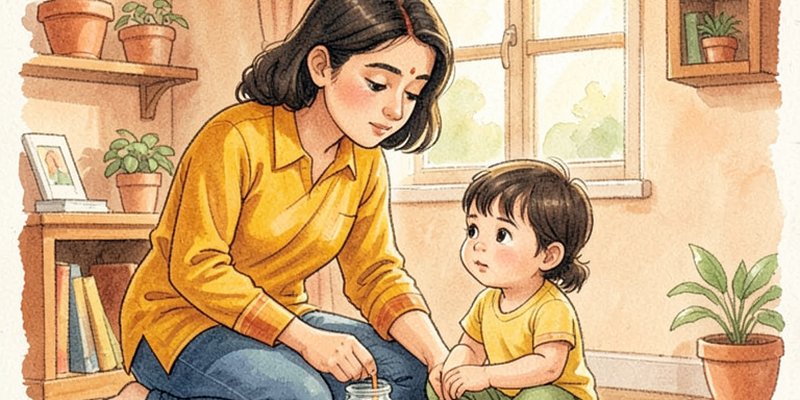
Age 6
Your child's tears set off something in you that is far larger than the moment deserves.

Age 9
You want to comfort them and realise you don't actually know what comfort looks like, because you weren't comforted.

Age 12
You find you need your child to be happy in order to feel okay yourself.
Age 14
A flash of resentment arrives — they have things you didn't — and then the guilt about the resentment.
Age 16
Grief shows up in the middle of something ordinary: a bedtime, a birthday, a scraped knee.

Now
You catch yourself, mid-reaction, parenting your own younger self rather than the child in front of you.
Swipe through the day
There is a particular kind of surprise that many parents describe and few expect. You are doing something entirely ordinary — soothing a crying child, watching them refuse dinner, sitting with them at bedtime — and something rises up in you that is far too large for the moment. A flash of anger. A wave of grief. A cold need to make the feeling stop.
That disproportion is the clue. When a reaction is bigger than the situation calls for, it is usually not really about the situation. It is about an older one.
Parenting has an uncanny way of surfacing your own childhood at exactly the ages you found hard the first time. The year your child turns the age you were when something happened, or didn't happen, you may find yourself unaccountably tender, or short, or sad. This is not a flaw in you. It is what happens when a person who was once a child raises a child of their own. The past does not stay in the past; it comes into the room, quietly, and sits down next to you.
Reparenting is the work of noticing when that has happened, and learning to steady the part of you that showed up — so that you can attend to the child who is actually in front of you.
The word has collected a lot of noise, so it is worth being plain about both halves.
Reparenting is the practice of giving yourself the steadiness you didn't receive. It is learning to comfort yourself, to speak to yourself with something other than contempt, and to meet your own hard moments the way a good parent would meet a child's. The outward purpose is simple: a parent who can steady themselves does not need their child to do it for them. You stop, without quite realising you were doing it, requiring your child to be happy so that you can feel like a good parent.
And it is worth being equally clear about what reparenting is not. It is not blaming your parents. It is not deciding they did everything wrong, or rewriting your childhood as a catalogue of injuries. It is not a personality transplant, and it is not therapy. This will not resolve everything, and any programme that promised it would be lying. Where this work touches genuine trauma, abuse, or neglect, it belongs with a therapist — and one of the things we do here is help you see that line clearly, rather than blur it.
Held within its real limits, though, this is some of the most useful work a parent can do. It reaches the part of you that no parenting technique ever will.
Most people expect that their childhood, if it affects their parenting, will show up as memory — something they can recall and reason about. More often it shows up as reaction.
An unmet need does not usually announce itself. It surfaces sideways, as a feeling that arrives faster than thought: the tightening when your child clings, the flare when they defy you, the flatness when they need comforting and you have none to give. You were not comforted in that particular way, and so the script is missing. What fills the gap is not a decision but a reflex.
This is why simply resolving to "do better" so rarely works on its own. You cannot reason your way out of a reflex you can't see. The work is to slow the moment down enough to notice the reaction, and then to become curious about it rather than ashamed of it — to ask, gently, where you have felt this before. Not to unearth a specific memory, but to recognise the pattern underneath. Once a pattern is visible, it stops running you quite so completely. That small gap, between the trigger and the response, is where all the freedom lives.
A great deal of advice tells parents to be kinder to themselves and then stops, as though kindness were a switch. It isn't. Self-compassion is a capacity, and like any capacity it is built through practice, awkwardly at first.
The practical version is smaller and more concrete than the word suggests. It is what you do in the ten seconds after you have snapped at your child — whether you spiral into self-attack, which helps no one, or whether you can say to yourself roughly what you would say to a friend who had done the same thing. Most of us are fluent in kindness toward others and near-mute in kindness toward ourselves. Borrowing your own generosity and turning it inward is a learnable move.
For many parents in India, contemplative practice — prayer, stillness, the traditions you may already keep — can support this work beautifully. It can also, if you're not careful, become a way of skipping past the hard feeling instead of sitting with it, a serene lid on an unopened box. We work with the practice you have, and we keep an eye on that particular trap, so that calm deepens the work rather than avoids it.
For most people who grew up in India, the previous generation raised children in a world where physical discipline was so ordinary it was nearly invisible, and where a parent's authority was not to be examined. To look honestly at how you were raised can feel, from the inside, like disloyalty — like a betrayal of people who genuinely sacrificed for you and loved you as best they knew how.
So here is the thing this work rests on, and it is worth saying slowly: gratitude and grief are not in competition. You can hold real, uncomplicated thankfulness for what your parents gave you and, in the same breath, real sorrow for what they couldn't. Both are true. Refusing the grief in order to protect the gratitude doesn't honour anyone; it just leaves the grief to leak out sideways, often onto your own children.
You do not have to choose. You do not have to confront anyone, or reach a verdict, or close the account. The task is only to let both things be true, and to carry them with a little less strain — keeping what you want to keep from how you were raised, and setting down, deliberately and with tenderness, what you don't want to pass on. That is quiet work, and slow, which is why it takes six months rather than six weeks. But it is the work that lets you stand in front of your child as the person you have decided to become, rather than the reflex you inherited.
Finish this sentence quietly, once: 'As a child, I needed more ___.' Not to build a case against anyone — just to let the need be true. Naming a need and blaming a person are different acts, and the first one is the one that heals.
The next time you get something wrong as a parent, try saying to yourself what you would say to a friend in the same moment. Most of us are far kinder to others than to ourselves. Borrowing that kindness for yourself is a skill, and it starts with one sentence.
When a reaction feels too big for the situation, don't act on it — just note it, and ask where you've felt this before. You are not looking for a memory. You are looking for the pattern underneath it.
That helps in the moment. Changing the pattern takes something else.
Six months of slow, honest inner work on the childhood you carry into the room every time you parent — the part of you that no parenting technique reaches, and that quietly shapes everything else.
We begin slowly, because the word carries a lot of noise. Reparenting is not blaming your parents, not a personality overhaul, and not therapy. It is a specific, practical capacity: learning to steady yourself. We also draw the line clearly around what this work cannot hold, so you know from the start where its edges are.
Why parenting surfaces your own childhood at exactly the ages you found hard the first time. We work with triggers not as failings but as information — reactions that arrive instead of memories. And we look at the needs that went unmet, gently, in a way that lets you name them without turning the naming into an indictment of the people who raised you.
Self-compassion is treated here as a capacity you build, not a sentiment you're told to feel. We work on the actual practice — what to do in the ten seconds after you've snapped, how to speak to yourself the way you'd speak to someone you love, and how contemplative practice can support this without tipping into spiritual bypass, where calm becomes a way of not looking.
The hardest and most freeing part. In many Indian homes, examining a parent's choices feels like disloyalty, and physical discipline was so common as to be invisible. We make room for both things to be true at once: real gratitude for what you were given, and real grief for what you weren't. You do not have to choose between them, and you do not have to confront anyone to do this work.
Small group — deliberately. Few enough that everyone is known, and no one is a spectator.
Message us to hear about dates, structure and fees for the next cohort.
Purnam is an AI-native parenting companion for modern Indian families. A structured programme, a smart companion that knows your family, and a small, honest community of parents — built to take you from surviving the day to thriving across the years.
Parenting that hasn't been handed down — for the generation that wants to parent differently than they were parented, but has no cultural template for it.
Purnam · our positioning
Purnam is built by a founding team with 18+ years across big tech, startups, and growth-stage technology companies — and, more to the point, by parents currently inside the early-childhood years themselves.
Parents to a toddler ourselves — building Purnam to help Indian families move from surviving to thriving.
Purnam's approach draws on modern developmental psychology — attachment, emotional regulation, behavioural coaching — held alongside Indian contemplative traditions as practical tools rather than belief.
We are advised by senior practitioners in human transformation and behavioural coaching. Where the evidence for something is strong, we say so. Where it is contested, we say that too.
Message us on WhatsApp about The Parent You're Becoming — dates, structure, fees, and whether it fits your situation.
Or just ask your actual question. That's what the line is for. Someone from the Purnam team will get back to you.
Purnam offers parenting support and education. This is not paediatric, medical, or mental-health treatment, and it is not a substitute for care from a qualified professional. Every child and family is different; nothing here is a promise of any particular outcome.