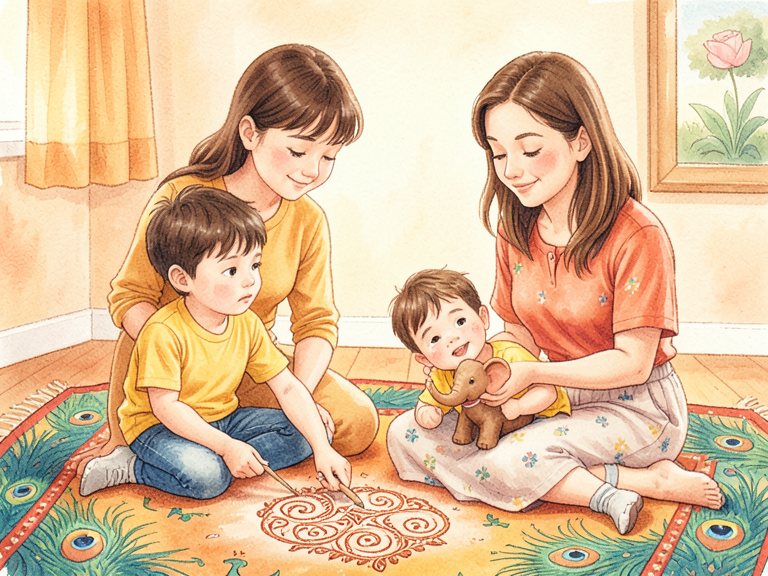
Monday
"Look at how well your cousin is doing" — out of your mouth before you'd decided to say it.
Out of the Comparison Trap ·12 months ·All ages
You already know comparison doesn't help. The difficulty is that most of it happens before you've decided to do it — a sentence out of your mouth about someone else's child before you've noticed you were going to say it. This programme is about noticing, and about what to put in its place.
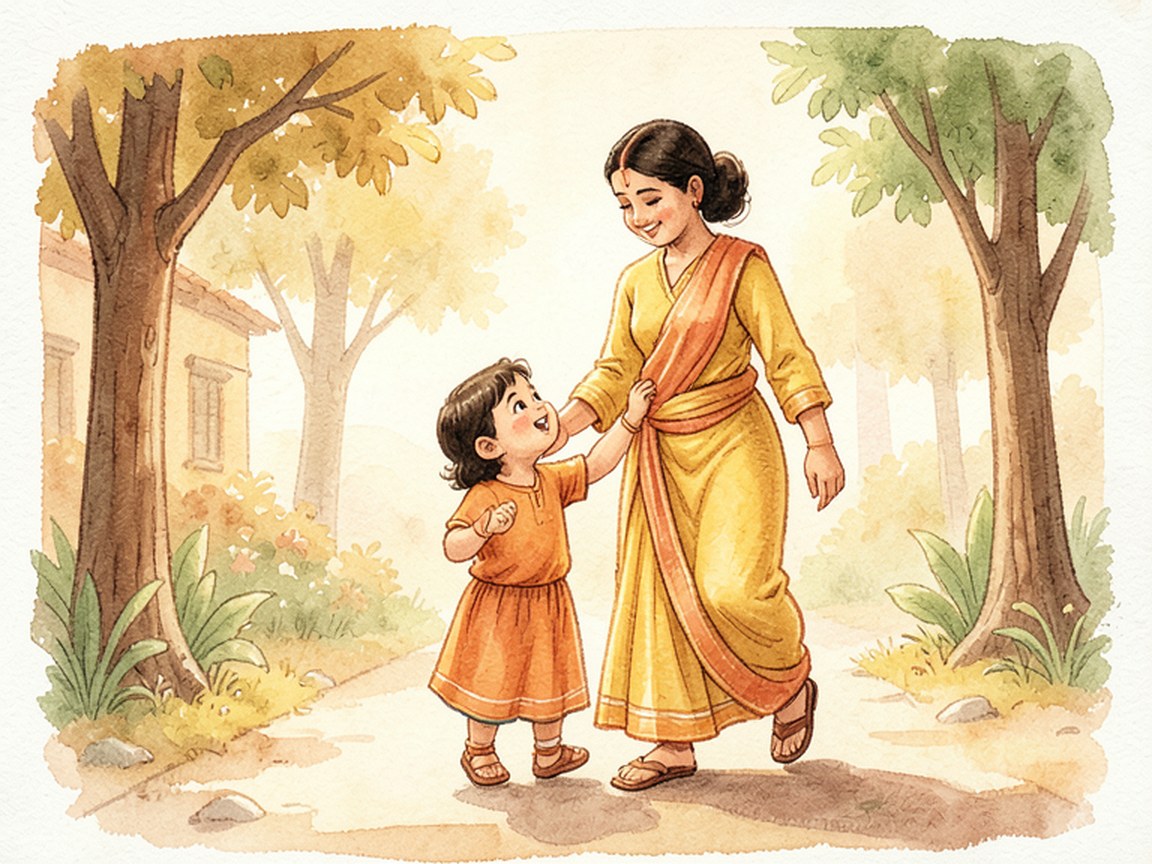
Comparison damages in both directions — the child measured against others learns their worth is conditional, and the parent measuring learns to see their own child less clearly. Stopping it is mostly a matter of noticing how often it happens, because most of it is reflexive rather than intended.
Read this first
When it has gone past comparison. If your child has begun speaking about themselves in a way that worries you — that they are worthless, a burden, or better off gone — that is no longer about comparison and it should not wait for a programme. Please speak to a qualified child mental-health professional promptly. This work sits alongside that kind of help, never in place of it.
One ordinary week in your house.
Monday
"Look at how well your cousin is doing" — out of your mouth before you'd decided to say it.

Tuesday
Relatives ranking the children openly at a family gathering, and nobody stopping it.

Wednesday
You catch yourself comparing your child to other parents' children, and feel the sting on both ends.
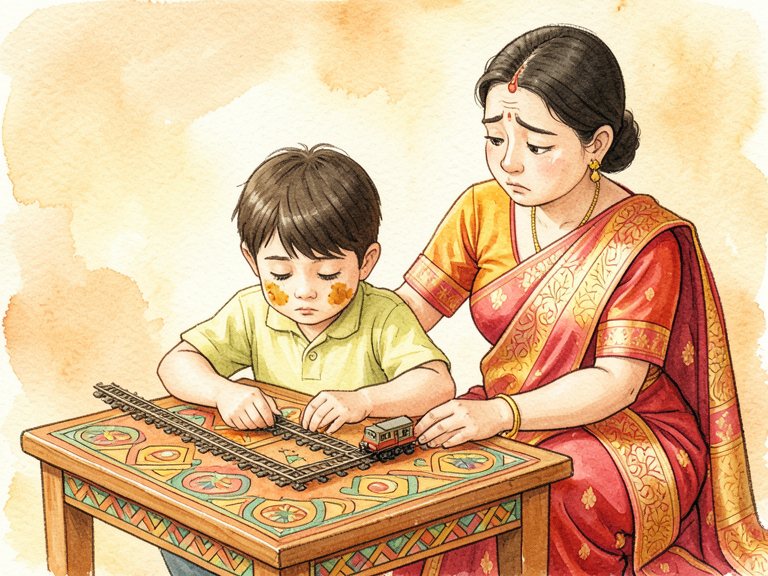
Thursday
Your child has started saying it about themselves — "I'm not as good as her."

Friday
Marks come home, and the first question you ask is where they stood, not what they learned.
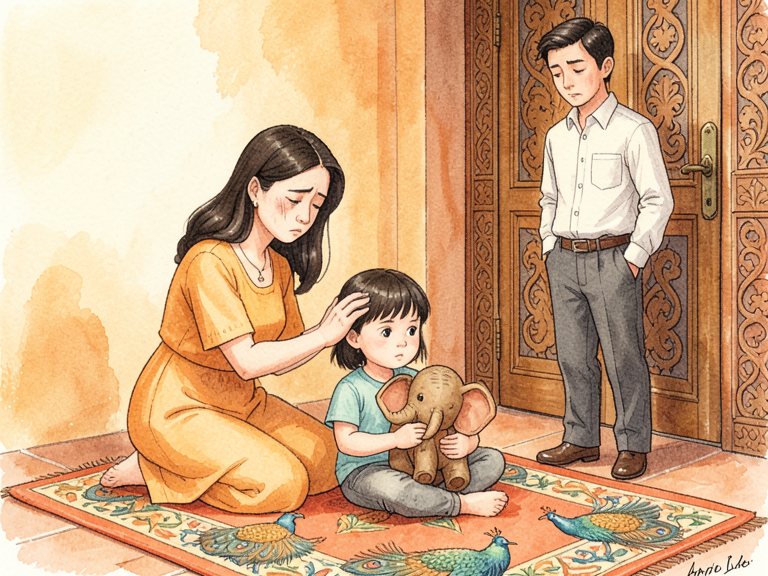
Saturday
You promised yourself you wouldn't do to them what was done to you, and then you hear your own mother's sentence in your voice.
Swipe through the day
Ask almost any parent whether comparing their child to others is a good idea, and they'll say no. They mean it. And then, an hour later, at a family lunch, a sentence arrives — look how nicely your cousin finishes her food — and it's out before any decision was made about saying it.
This is the part that most advice misses. Comparison is not usually a considered parenting choice you could simply reverse by choosing differently. It is a reflex. It fires under stress, at gatherings, when marks come home, when another parent mentions their child's achievement and something in you needs to answer. You can hold a firm intention not to compare and still do it a dozen times before dinner, because the intention lives in one part of you and the reflex lives in another, older part.
That's why "just stop comparing" doesn't work, and why hearing it mostly produces guilt rather than change. You can't stop a habit by disapproving of it. You stop it by first being able to see it happen.
Comparison is usually discussed as something that happens to the child. It does, and the damage is real: a child measured repeatedly against others learns, slowly and without anyone intending it, that their worth is conditional. Not that they did a thing well or badly, but that being loved depends on where they place. That lesson doesn't announce itself. It settles in quietly and shows up years later as a person who cannot rest, or cannot fail, or cannot believe an achievement is enough.
But there is a second direction that gets almost no attention. Comparison damages the parent's sight. When you are habitually measuring your child against a cousin or a classmate, you stop seeing the child in front of you and start seeing a position on a ladder. The particular things about them — the odd questions, the specific kindness, the way they are actually built — become invisible, because a ladder has no room for particulars. It only has higher and lower.
So the case against comparison isn't only that it hurts the child. It's that it costs you the ability to know your own child clearly. Both losses are worth stopping for.
This will not switch off in a week, and any programme that promised to end it that fast would be lying — a reflex laid down across your own childhood does not lift on command. What changes, and what a year is long enough to build, is your ability to catch it.
The defence of comparison is always the same: a little of it pushes children to do better. And it's true that you can find a child who was stung by a comparison and worked harder because of it.
But look at what actually happened. The child didn't work harder because comparison is a good teacher. They worked harder to stop the pain of being found lesser. That's a fear engine, and fear engines run hot and then break. The child either burns out, or learns to avoid the arenas where they might lose, or succeeds and discovers that the success bought them nothing lasting because the measuring never stops — there is always another cousin, another rank, another neighbour's child.
Motivation that lasts tends to come from somewhere else entirely: interest, mastery, the plain satisfaction of getting better at a thing. Comparison doesn't build any of those. At best it borrows against them.
It would be dishonest to talk about this as a private family habit, because in most Indian households it isn't private and it isn't only yours. Comparison is arguably the defining feature of the culture the average conscientious parent is trying to raise their child out of. It's in the schooling, which is built on rank. It's in the marks, which are read aloud and posted. It's in the cousins, the neighbours, and the reflex the whole culture has a name for — Sharma-ji ka beta, the other family's son who is always doing better.
This matters for two reasons. First, it means you are not the only source of comparison in your child's life, and often not the loudest — which is why a good part of this work is about protecting your child from other people's measuring, not just stopping your own. And second, it means the reflex in you was installed by a system, not chosen by you, which is the beginning of being able to set it down without spending the whole time in shame.
Parents who do this work describe a similar arc. Early on, they simply start to hear themselves — the comparisons that used to pass unnoticed become audible, which is uncomfortable but is the whole point. Then the catching moves earlier, from noticing after the sentence to noticing during it, and finally to a beat of space before it where a different response can go.
Alongside that, something changes in how they handle the outside pressure — a sentence ready for the relative who ranks the children, a private word for the child afterwards, a steadier way to receive a report card. None of it makes the culture disappear. The gatherings still happen and the marks still come home. What changes is that the message that their worth is a position stops coming from you, at least — and they are seen, by the person whose sight matters most, as the particular child they actually are.
Don't try to stop them — just count. Every time you measure your child against a sibling, a cousin, a classmate, or another parent's child, make a mark. Most parents are startled by the number. You can't interrupt a habit you can't see, and the count is how you start to see it.
The next time someone ranks your child out loud — a relative, a neighbour, a teacher — say one gentle sentence that closes it rather than continuing it. "They're both doing their own thing" is enough. Your child is watching whether you let it stand.
When marks or results come home, notice the first question you ask. If it's about rank or about someone else, replace it — just once — with a question about the child in front of you. "What was the hardest part?" tells them what you're actually measuring.
That helps in the moment. Changing the pattern takes something else.
A year on the single habit that most defines the culture you're trying to raise your child out of — the marks, the ranks, the cousins, and the reflex to measure. Long enough to change something that runs this deep.
Before changing anything, we look plainly at the mechanism — how measuring a child against others teaches conditional worth, and why comparison so rarely motivates the way it promises to. We separate the two directions of the damage: what it does to the child being measured, and what it does to your own ability to see the child you actually have.
The slow, patient work of noticing comparison in your own speech before it lands — because most of it is automatic, inherited, and out before you've chosen it. We work on the specific sentences, the family occasions that trigger them, and a way to catch yourself mid-sentence without shame, since shame just adds another thing to the pile.
You are not the only source of comparison, and often not the loudest. This quarter is about the relatives who rank openly, the school built on it, and the neighbourhood that runs on "Sharma-ji ka beta." We work on the language to interrupt public comparison without a scene, and on what to say to your child afterwards.
How to hold a real relationship with school results without letting rank become the measure of your child. We work on what to do when the results are genuinely poor, how to talk about effort without it becoming a slogan, and how to keep the year's change alive once the programme ends and the family gatherings keep coming.
Small group — deliberately. Few enough that everyone is known, and no one is a spectator.
Message us to hear about dates, structure and fees for the next cohort.
Purnam is an AI-native parenting companion for modern Indian families. A structured programme, a smart companion that knows your family, and a small, honest community of parents — built to take you from surviving the day to thriving across the years.
Parenting that hasn't been handed down — for the generation that wants to parent differently than they were parented, but has no cultural template for it.
Purnam · our positioning
Purnam is built by a founding team with 18+ years across big tech, startups, and growth-stage technology companies — and, more to the point, by parents currently inside the early-childhood years themselves.
Parents to a toddler ourselves — building Purnam to help Indian families move from surviving to thriving.
Purnam's approach draws on modern developmental psychology — attachment, emotional regulation, behavioural coaching — held alongside Indian contemplative traditions as practical tools rather than belief.
We are advised by senior practitioners in human transformation and behavioural coaching. Where the evidence for something is strong, we say so. Where it is contested, we say that too.
Message us on WhatsApp about Out of the Comparison Trap — dates, structure, fees, and whether it fits your situation.
Or just ask your actual question. That's what the line is for. Someone from the Purnam team will get back to you.
Purnam offers parenting support and education. This is not paediatric, medical, or mental-health treatment, and it is not a substitute for care from a qualified professional. Every child and family is different; nothing here is a promise of any particular outcome.