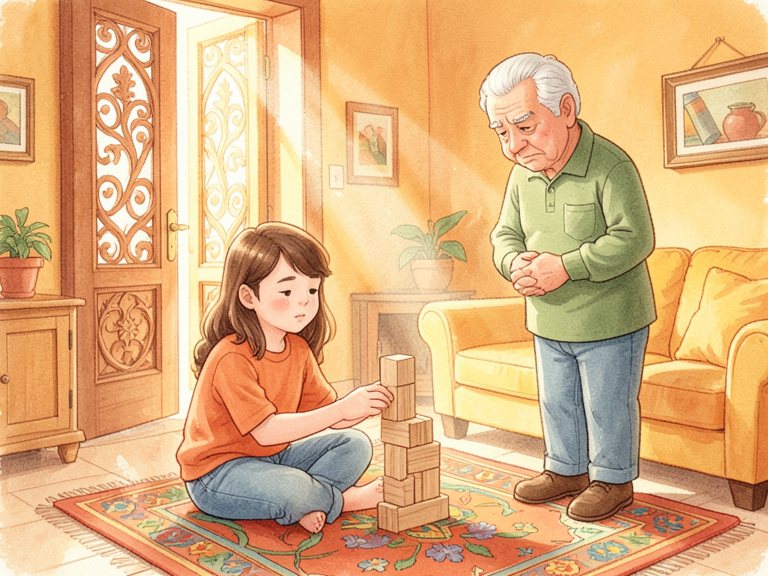
Monday
The relative who comments on your child's weight, height, or complexion at every single gathering.
Boundaries Without Rupture ·3 months ·All ages
Aunts, uncles, cousins and family friends who comment, compare and advise — people with no say in how you raise your child, whose opinions still land hard. This is a focused programme on holding a boundary that doesn't require winning a fight every time.

Most intrusive advice is an attempt at connection delivered badly, which is why treating it as an attack tends to escalate it. Boundaries hold best when they're low-drama and repeatable — a short, warm, unvarying response used consistently, rather than a confrontation that has to be won once. Consistency outperforms intensity here almost every time.
Read this first
One thing that is not a boundary problem. If a relative's behaviour touches your child's safety — anything you've seen, anything your child has said, or a feeling you can't quite place — that is not something to manage with a warm, repeated sentence. Act on it directly and immediately: keep your child away from the risk, speak to them plainly, and where it is warranted involve the people whose job this is. A boundary is for commentary, not for harm.
One ordinary week in your house.
Monday
The relative who comments on your child's weight, height, or complexion at every single gathering.
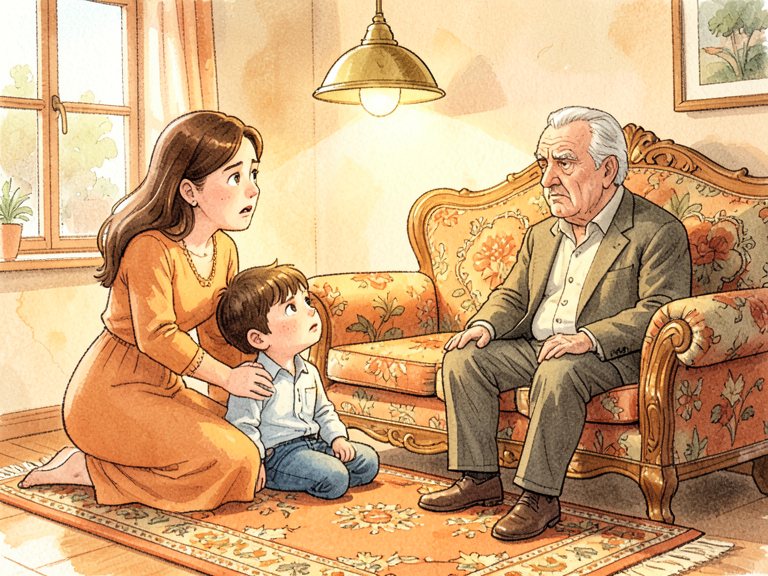
Tuesday
Advice you never asked for, delivered in front of a room full of people.

Wednesday
Your child compared, out loud, to a cousin who eats better, scores higher, or sits more still.

Thursday
Someone feeding your child the exact thing you'd just said no to, with a smile.
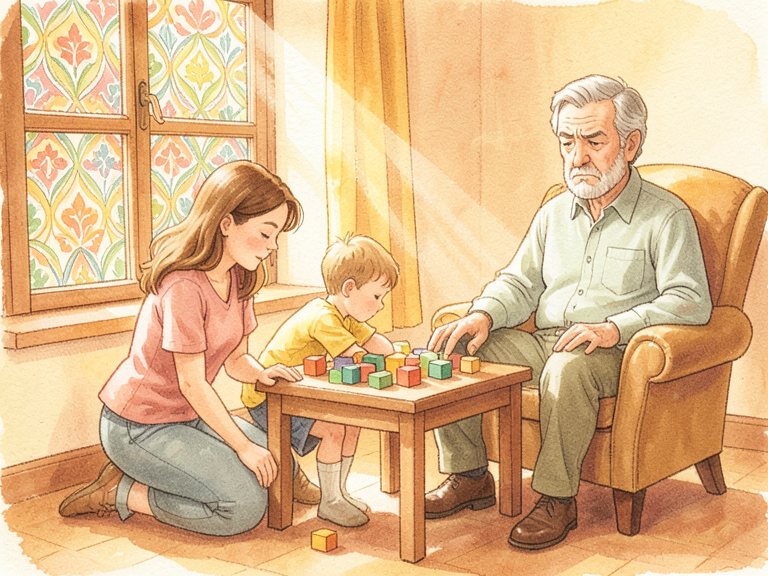
Friday
Criticism of your working — or, from someone else, of your not working.

Saturday
The family WhatsApp group, where an offhand line can occupy your whole evening.
Swipe through the day
There is a particular kind of tiredness that comes from the wider family. Not the daily grind of the household you share — that is its own thing — but the aunts, uncles, cousins and old family friends who appear at gatherings, on calls, and in group chats, and who always seem to have a view on how your child is being raised.
They have no say in it. That is the strange part. These are people with no responsibility for the outcome and no authority over your decisions, and yet a single line about your child's weight, or your choice to work, or how much screen time you allow, can occupy your mind for the rest of the day.
It lands hard because it isn't really about the topic. A comment about your child's plate is rarely a considered nutritional opinion. It is a way of staying involved, of asserting seniority, of expressing an anxiety the relative may not even be aware of. Understanding that doesn't make the comment acceptable. But it changes what you are dealing with, and therefore how you should respond.
Here is the reframe that changes the most.
When someone offers advice you didn't ask for, the instinct is to hear it as a judgment on you — that you are getting something wrong, that they can see it, that everyone in the room can see it. That reading is what makes the comment sting, and it is usually incorrect.
Most unsolicited advice is an attempt at connection delivered badly. The relative wants to be involved in your child's life and doesn't have a better vocabulary for it than commentary. The comparison to a cousin's child is often clumsy affection, not contempt. The remark about complexion is, more often than not, an inherited reflex the person has never examined.
None of this makes it your job to absorb it. But when you stop hearing every comment as an attack, you stop responding as though you are under attack — and that single shift lowers the temperature of almost every exchange. The relatives who intrude the most are frequently the ones most desperate to matter. Treated as combatants, they escalate. Treated as slightly tiresome well-wishers, they tend to settle.
Most people try to hold boundaries with intensity. They wait until they can't take it anymore, and then they push back hard — a sharp reply, a confrontation, a scene. It feels like strength, and it almost never works.
The problem with intensity is that it has to be repeated to be believed, and repeating intensity is exhausting and corrosive. A boundary won in a single dramatic confrontation tends to be re-tested at the next gathering, because a one-off outburst reads as a mood, not a rule.
What actually holds is the opposite: a boundary so low in drama that it barely registers as one. A short, warm, unvarying sentence, used every single time. "We're happy with how she's doing." "We've got this one covered, thank you." Said the same way, in the same tone, without elaboration, again and again.
The consistency is the whole mechanism. A response that never changes and never escalates gives the other person nothing to grab. There's no argument to win, no offence to take, no crack to work at. Over time — and it does take time — the comment simply stops coming, because it stopped being interesting to make.
This is slow. It will not end the commentary this week, and any programme that promised it would be lying. What it does, reliably, is take the charge out of the exchanges while the pattern gradually fades. That is a better outcome than a victory that has to be re-won every festival season.
Not everything deserves a response. This is worth saying plainly, because a great deal of the exhaustion here comes from treating every comment as a battle that must be fought.
Draw the line between opinion and action.
An opinion is something that was only said. Your child is too thin. You're spoiling her. In our time we didn't do it this way. These land, sometimes hard, but they change nothing on their own. Most of them can be met with your one warm sentence, or with nothing at all. Silence is a complete response, and often the strongest one.
An action is something that was done. Food given to your child after you said no. A rule undermined in front of them. A punishment or a bribe you didn't sanction. This is a different category, and it needs a different, firmer register — not a warmer version of the same script, but a clear, direct line about what will and won't happen with your child. You can be pleasant and still be immovable.
Keeping these two apart saves you. It means you aren't spending your finite patience arguing about opinions, so that when a genuine action needs stopping, you have the standing and the composure to stop it.
There is one form of intrusion that is not a matter of your comfort at all, and it is the reason this work matters most.
In a great many Indian families, remarks about a child's body are constant — too dark, too thin, too fat, too short, why doesn't she eat, look how fair the cousin is. They are delivered casually, often affectionately, frequently in front of the child. And they do real, lasting damage. A child hears these comments long before they can weigh them, and colourism and body commentary absorbed young have a way of settling in and staying.
This is where the low-drama boundary gives way to something firmer. You are no longer managing your own irritation; you are protecting someone who cannot yet protect themselves. That warrants a clear interruption in the moment — a redirect, a change of subject, a plain "we don't talk about her body like that" — and, just as importantly, something said to your child afterward. What they most need to know is that the comment was not the truth about them, and that you don't agree with it.
The cultural weight here is real, and pretending otherwise produces advice that doesn't work. Elders in many families carry an assumed right to comment, and the social cost of contradicting them falls hardest on women, who are expected to keep the peace. Naming that openly is part of how we work on it, because a strategy that ignores who actually pays the price for a boundary isn't a usable strategy.
You will not change the whole culture at a family lunch. But you can hold a line around your own child, calmly and repeatedly, and that line is one of the more valuable things you can give them.
Pick a single warm, neutral line — "We're happy with how she's doing, thank you" — and decide in advance to use it every time, word for word. The power is in the sameness. A response that never varies stops being an invitation to argue.
Draw a line down a page. On one side, things that were only said. On the other, things that were done — food given, a rule overridden. You can let most opinions pass. It's the actions that need a boundary, and knowing the difference saves enormous energy.
When a comment lands about your child's plate or appearance, move rather than debate — change the subject, change the room, hand the child a task. Physical redirection ends a moment that an argument would only extend.
That helps in the moment. Changing the pattern takes something else.
Three months on the commentary from the wider family — the aunts, uncles, cousins and family friends who advise, compare and remark, and who almost every Indian parent is quietly managing without a script.
Before building any boundary, we look honestly at where the commentary comes from. Most intrusion is less about your parenting than about the relative — their anxiety, their era, their own way of staying involved. Seeing that clearly changes what you feel in the moment, and stops you responding to an attack that was never really one.
The heart of the programme: the brief, warm, unchanged, repeated response — and why consistency outperforms intensity every time. We work on your actual sentences, in Hindi and English, for the situations you keep meeting. The aim is a boundary you can hold on a bad day, in a full room, without a scene.
Not everything deserves a response, and treating every comment as a battle exhausts you and hardens them. We separate the opinions you can let go from the actions you genuinely have to stop — food given against your word, a rule undermined in front of your child — and build a different, firmer register for the second kind.
The part that matters most: shielding your child from remarks about their body, weight and complexion, which in the Indian context are constant and do real damage. How to intervene in the moment, what to say to your child afterwards, and how to hold this line even with elders whose right to comment feels culturally settled. We also address the family WhatsApp group and the disproportionate social cost this work carries for women.
Small group — deliberately. Few enough that everyone is known, and no one is a spectator.
Message us to hear about dates, structure and fees for the next cohort.
Purnam is an AI-native parenting companion for modern Indian families. A structured programme, a smart companion that knows your family, and a small, honest community of parents — built to take you from surviving the day to thriving across the years.
Parenting that hasn't been handed down — for the generation that wants to parent differently than they were parented, but has no cultural template for it.
Purnam · our positioning
Purnam is built by a founding team with 18+ years across big tech, startups, and growth-stage technology companies — and, more to the point, by parents currently inside the early-childhood years themselves.
Parents to a toddler ourselves — building Purnam to help Indian families move from surviving to thriving.
Purnam's approach draws on modern developmental psychology — attachment, emotional regulation, behavioural coaching — held alongside Indian contemplative traditions as practical tools rather than belief.
We are advised by senior practitioners in human transformation and behavioural coaching. Where the evidence for something is strong, we say so. Where it is contested, we say that too.
Message us on WhatsApp about Boundaries Without Rupture — dates, structure, fees, and whether it fits your situation.
Or just ask your actual question. That's what the line is for. Someone from the Purnam team will get back to you.
Purnam offers parenting support and education. This is not paediatric, medical, or mental-health treatment, and it is not a substitute for care from a qualified professional. Every child and family is different; nothing here is a promise of any particular outcome.