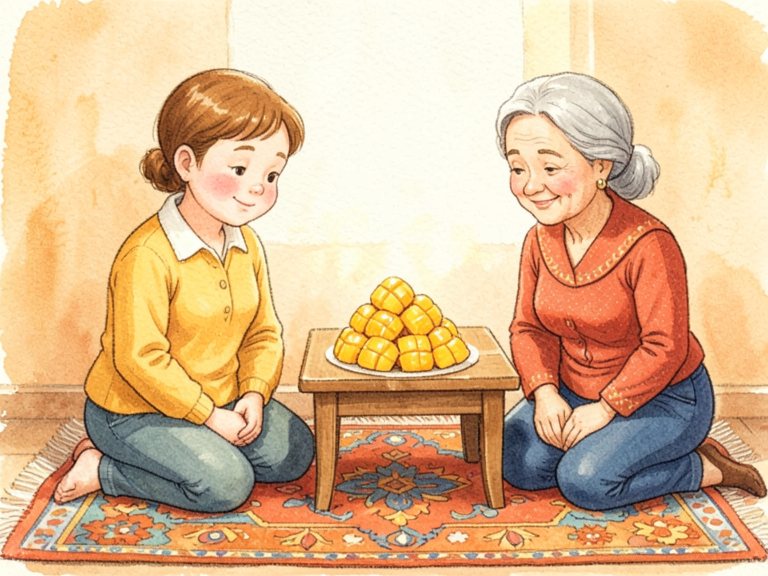
Monday
The sweet appears within minutes of your no — sometimes before you've left the room.
Two Generations, One Home ·3 months ·1 – 12 years
Grandparents overriding your rules is rarely a verdict on your parenting. It is usually how they love a child they aren't responsible for all day. This is a focused programme on choosing the few things that genuinely need alignment — and holding them without a war.
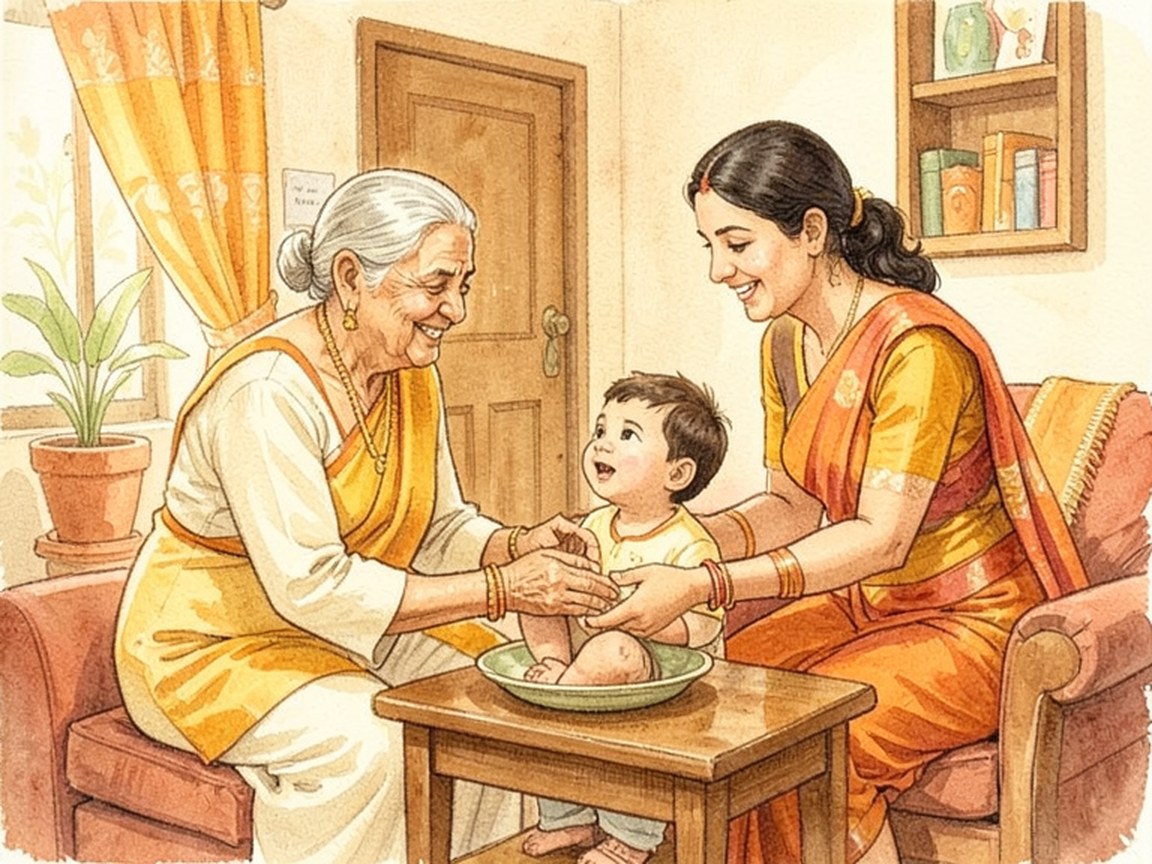
Grandparents overriding your rules is usually about their relationship with the child, not a judgment on your parenting — indulgence is often how they express love without daily responsibility. Consistency matters most on a small number of things, so the practical move is choosing which few genuinely require alignment and letting the rest go.
Read this first
One thing that isn't about rules. This programme is for indulgence and inconsistency — the sweets, the screens, the undone routine. If a grandparent's care raises a genuine safety concern for your child, that is not a boundary to negotiate over three months. Act on it directly and immediately, and involve a qualified professional if you need one. Please don't wait for a programme.
One ordinary week in your house.
Monday
The sweet appears within minutes of your no — sometimes before you've left the room.

Tuesday
The screen you'd carefully restricted is on, because 'he was just sitting there'.

Wednesday
You're contradicted in front of the child, and now you're the strict one and they're the fun one.
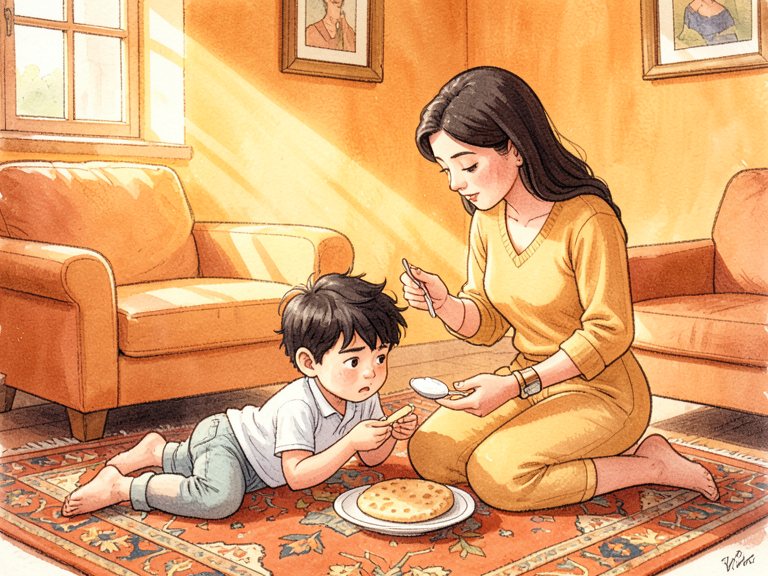
Thursday
A weekend visit undoes a month of patient work on sleep or food, and you start again on Monday.
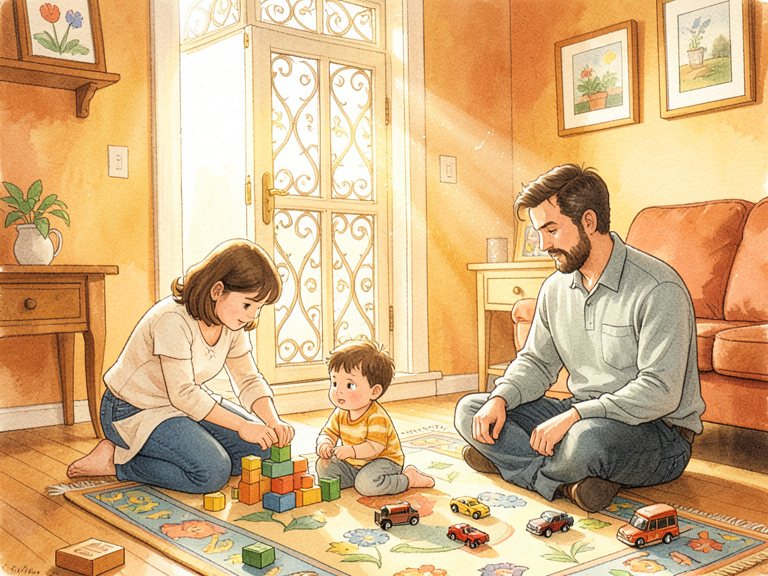
Friday
They're the daytime caregivers while you work, so 'their house, their rules' is happening in your house too.

Saturday
You want to say something, but they're your parents — or worse, your in-laws — and you don't know how.
Swipe through the day
Start with the thing that changes everything: when a grandparent overrides your rule, they are usually not making a statement about your parenting. They are expressing love in the currency they have.
A grandparent who slips a child a sweet after your clear no is not, in most cases, contesting your authority. They are enjoying a form of love that has almost no cost to them — the indulgence without the consequence. They will not be up at 2 a.m. with the sugar crash, or holding the line the next time the child asks. That asymmetry is the whole picture. Indulgence is easy precisely because the daily responsibility sits with you, not them.
This matters because it tells you what you're actually dealing with. If the overriding were defiance, you'd need to win an argument. Because it's love without responsibility, you need something else entirely: a way to redirect the affection without insulting it, and a small number of places where you simply don't bend.
Most parents in this situation carry a specific fear: that the mixed signals are confusing or harming the child. It's worth being precise here, because the fear is aimed at the wrong target.
Children are unexpectedly good at context. That the rules at nani's house differ from the rules at home is a distinction a young child absorbs early and without distress — the same way they learn that the classroom and the playground run on different rules. Two reasonable-but-different regimes in two different places is something a child handles easily.
What children do not handle well is open contradiction between adults in the same moment. When you say no and a grandparent says yes in front of the child, the rule stops being a rule and becomes a negotiation with two parties to lobby. That is the thing worth protecting against — not the existence of different rules, but the public overruling that teaches a child to shop for the answer they want.
So the goal is not uniformity everywhere. It is to move the disagreement off-stage, and to reserve your firmness for the few places it genuinely belongs.
Here is the practical core. You cannot align a grandparent on everything, and trying is how parents exhaust themselves and sour the relationship. You can align them on three things.
Choosing your three is an exercise in subtraction. It usually means naming the handful of limits that are genuinely load-bearing — often something around safety, sleep, or a specific screen or food boundary you've decided matters — and then, deliberately, releasing your grip on the rest. The extra biscuit, the later bedtime on a Saturday, the small spoiling that comes with being adored: these are not the battles. Deciding to stop tracking them, on purpose, is very different from losing them by slow attrition. It frees your attention and, just as importantly, it makes your three non-negotiables credible. A parent who fights on twenty fronts is easy to ignore. A parent with three clear lines is not.
This will not turn two households into one, and any programme that promised to make grandparents parent exactly as you do would be lying — and would be asking for something you probably don't even want. The aim is narrower and more achievable: alignment where it counts, latitude everywhere else.
Then there is the part that makes this uniquely hard in an Indian family: you are being asked to correct someone you were raised to defer to. Sometimes your own parent. Often your spouse's.
The instinct is to state the problem plainly, and it almost always backfires, because "you're giving him too many sweets" is heard as a judgment and answered with defence. The approach that works reframes the whole exchange. You raise it privately, never in front of the child. You move it off your parenting and onto a shared goal — the child's sleep, a limit you're actively working on — so you and the grandparent are on the same side of the problem rather than opposite sides. And you ask for help rather than demand a change: an elder who is asked to help will often help; an elder who is told they're wrong will dig in.
There is also the blood-relative rule, which spares a great deal of grief. The conversation with your own parents should usually come from you, and the conversation with your in-laws should usually come from your spouse. Correction from the person's own child lands as family; correction from the son- or daughter-in-law lands as an outsider's complaint, however gently it's put.
For many urban Indian families, grandparents aren't occasional visitors — they're the reason both parents can work. They do the day: the meals, the naps, the hours between school and evening.
When that's the arrangement, blanket rules are the wrong tool and can quietly wound. A grandparent giving up their retirement to raise your child does not want to feel supervised in the bargain. Here the three-things approach earns its keep twice over: a genuinely short list of non-negotiables, paired with visible trust on everything else, lets them feel like the co-parents they in fact are rather than staff following instructions. You hold the few lines that matter, and you hand them real latitude on the rest — not as a concession, but because it's both kinder and more effective.
None of this requires less closeness between your child and their grandparents. In almost every case, it requires a clearer agreement between the adults, so that the closeness can stay exactly as warm as it is.
Not thirty. Choose the three things that genuinely can't be flexible — often something around safety, sleep, or a specific food or screen limit — and get clear that everything else is negotiable. A short list is one you can actually defend.
The extra biscuit at nani's house is not the hill. Decide, on purpose, which indulgences you're going to stop tracking. Choosing to release them is different from losing them by attrition, and it frees you to hold the line where it counts.
Raise the one thing that matters when the child is asleep or elsewhere, and frame it as a request, not a correction. 'Can you help me with bedtime — he's a nightmare the next day' lands very differently from 'stop giving him sweets'.
That helps in the moment. Changing the pattern takes something else.
Three months on the relationship every Indian parent negotiates and almost nobody discusses honestly — the grandparents who adore your child and quietly rewrite your rules.
Before changing anything, we build an honest picture of the pattern — where the overriding happens, how often, and what it's really about. Most of what looks like defiance of your rules is a grandparent expressing love in the only currency they have daily access to. Naming that accurately changes what you do next.
Children are far more robust to 'different rules at different houses' than most parents fear — they learn contexts easily. What they don't handle well is being openly contradicted between adults in the same moment. We separate the inconsistencies that are harmless from the few that genuinely undermine you, so you stop fighting the wrong battles.
The three-things approach applied to your specific household — deciding what genuinely requires alignment and communicating it as a small, defensible list. We also work on the difference between correcting your own parents and your in-laws, and why the parent whose blood relative it is should usually lead that conversation.
The specific language for asking an elder to change something without rupture — in Hindi and English — and, harder, how to hold it when the sweets reappear next week. We cover the daytime-caregiver situation directly, and how to keep the relationship warm while the boundary stays firm.
Small group — deliberately. Few enough that everyone is known, and no one is a spectator.
Message us to hear about dates, structure and fees for the next cohort.
Purnam is an AI-native parenting companion for modern Indian families. A structured programme, a smart companion that knows your family, and a small, honest community of parents — built to take you from surviving the day to thriving across the years.
Parenting that hasn't been handed down — for the generation that wants to parent differently than they were parented, but has no cultural template for it.
Purnam · our positioning
Purnam is built by a founding team with 18+ years across big tech, startups, and growth-stage technology companies — and, more to the point, by parents currently inside the early-childhood years themselves.
Parents to a toddler ourselves — building Purnam to help Indian families move from surviving to thriving.
Purnam's approach draws on modern developmental psychology — attachment, emotional regulation, behavioural coaching — held alongside Indian contemplative traditions as practical tools rather than belief.
We are advised by senior practitioners in human transformation and behavioural coaching. Where the evidence for something is strong, we say so. Where it is contested, we say that too.
Message us on WhatsApp about Two Generations, One Home — dates, structure, fees, and whether it fits your situation.
Or just ask your actual question. That's what the line is for. Someone from the Purnam team will get back to you.
Purnam offers parenting support and education. This is not paediatric, medical, or mental-health treatment, and it is not a substitute for care from a qualified professional. Every child and family is different; nothing here is a promise of any particular outcome.