07:10
The meltdown arrives every single time, the instant the tablet goes away.
Screens Without the War ·3 months ·2 – 12 years
The meltdown doesn't arrive during the show — it arrives the moment it ends. This is a programme on bringing the screen time down and making your limits hold: the handover, the rules, and getting every adult in the house pulling the same way, rather than finding a stricter app.

Reducing screen time is less about tighter controls than about the transition off the screen, which is where the meltdown reliably happens. Households that struggle least tend to hold a few clear limits, agreed in advance and applied consistently by every adult, rather than more sophisticated software. The conflict is relational, not technical — which is why the amount comes down for good only once the daily fight over it does.
Read this first
Two things this programme is not for. If gaming or a device has crossed from a daily argument into something that has displaced your child's sleep, eating, school or friendships, that is not a rules-and-transitions problem and it deserves a qualified professional, not a twelve-week course on handovers. And if something has already happened online — a contact, a message, an image, anything that has frightened you or your child — act on it directly and now, rather than waiting for a session. Please don't sit on either of these.
Six moments from a single ordinary day.
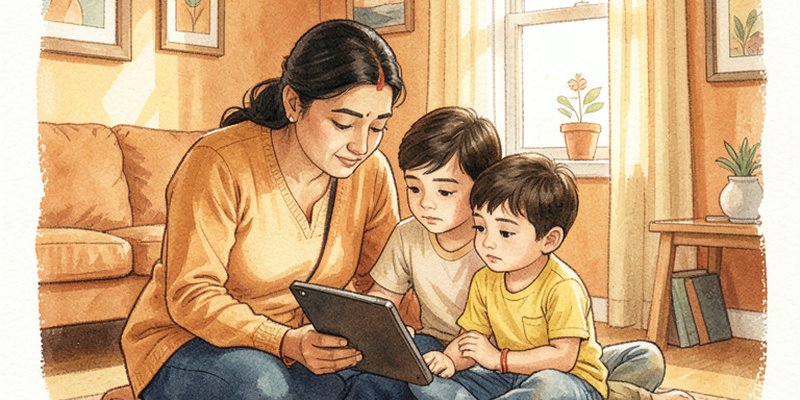
07:10
The meltdown arrives every single time, the instant the tablet goes away.

13:00
You hand over the phone at the restaurant to buy twenty minutes of peace — and feel the table judging you.

16:45
The nanny reaches for a screen the moment things get hard, because it's the tool that works fastest.

18:30
You set a limit; a grandparent quietly overrides it, and now you're the villain.
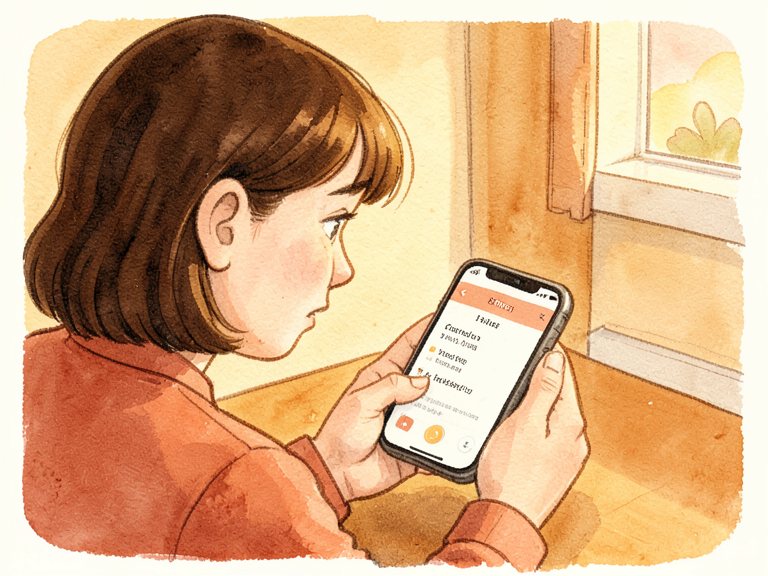
20:15
You check the screen-time report and discover how much has actually been watched.
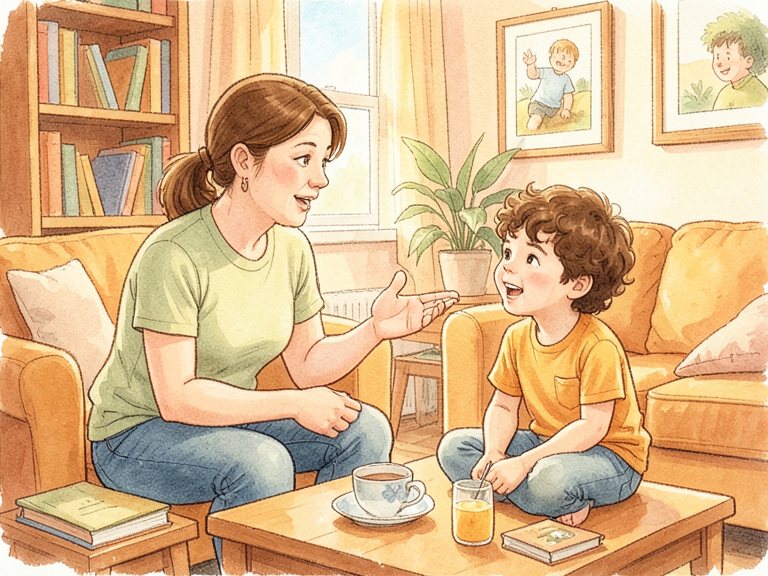
20:40
You are losing a reasoned argument about fairness to a seven-year-old, and you know it.
Swipe through the day
Most parents come to screen time believing the problem is quantity. Too many minutes, too many shows, a number that keeps creeping up. So they reach for the tools built for a quantity problem: a stricter app, a locked device, a schedule taped to the fridge.
And for a while, sometimes, the number comes down. What almost never comes down is the fighting.
That's the tell. If tightening the limit doesn't reduce the conflict, the conflict was never really about the limit. Watch your own household closely for a week and you'll usually see it — the trouble doesn't arrive while your child is watching. It arrives the moment the watching stops. The screen isn't the battlefield. The transition off it is.
This is not a small distinction. It changes what you work on. A quantity problem is solved with better controls. A transition problem is solved with better handovers — with warnings, with rituals, with something predictable waiting on the other side of "done." One of those is a software purchase. The other is a skill, and it's learnable.
There is an entire industry built on the premise that screen conflict is a technical problem. Set the timer, filter the content, get the weekly report. If the friction were really about minutes, this would work, and you wouldn't be reading this.
The reason it doesn't is that the conflict is relational, not technical. When your child melts down as the tablet goes dark, they are not protesting a number. They are protesting a loss, badly timed and abruptly delivered, with nothing to soften it. When your nanny hands over the phone, she is not defying your policy; she is using the one tool that reliably buys her a quiet twenty minutes on a hard afternoon. When a grandparent waves the rule away, that is not a settings problem either.
An app can enforce a boundary. It cannot agree one, and it cannot hold a boundary that the other adults in the house haven't agreed to. This is why the same families cycle through app after app: each new one addresses the mechanism and none of them touch the relationship, so the fight simply relocates. The work that actually helps is upstream of any software — and none of it requires you to become the household's screen police.
If you change one thing, change the ending.
A screen that stops without warning is experienced by a young child as something taken, suddenly, in the middle. A screen that ends inside a predictable ritual is experienced as a thing that was always going to end — and the difference in how those two land is enormous. The mechanics are unglamorous and they work: a genuine warning with enough runway ("one more, then we're finished"), a consistent verbal cue, and — the part most parents skip — a defined next thing. The end of a screen should be a doorway into something else, not a fall off a cliff into nothing.
This will not end tantrums, and any programme that promised to would be lying. A tired, dysregulated four-year-old will sometimes melt down no matter how cleanly you handle the handover, because the meltdown is about being four as much as about the screen. What a good ritual does is remove the entirely avoidable meltdowns — the ones caused not by the loss itself but by the shock of how it happened — which turns out to be most of them. You are not aiming for zero. You are aiming for far fewer, and for a version of "no" that you can deliver the same calm way every time.
Almost every article you'll read on screen time was written for a household with two parents, one home, and no other adults in the decision. That is not most Indian homes, and the gap is exactly where the real difficulty lives.
Start with the caregiver. If a nanny or didi is with your child for a large part of the waking day, and a screen is her fastest tool for a hard moment, then no rule you set survives the hours you aren't there — not because she's defying you, but because she has nothing else to reach for. A rule without a replacement lasts about a week. The work here is giving her alternatives that actually function on your particular child, and agreeing the limit with her rather than handing it down. This is close enough to our programme on working with a caregiver that the two are best done with an eye on each other.
Then the joint family. In a household with grandparents, screen rules are rarely broken by the child first; they're softened by an adult who loves the child and reads a limit as harshness. You cannot app your way past that, and you cannot win it by decree. It is a conversation between adults, and it needs the kind of framing that lets a grandparent hold a boundary without feeling corrected in their own home.
And then the two quiet ones. The mealtime screen that began as the only way the plate got finished, and is now load-bearing in ways that make it hard to simply remove. And phone-based schooling, which has blurred the line between the device as a tool and the device as a toy so thoroughly that "get off the screen" no longer means anything clear to a child who was, ten minutes ago, on the same screen for class. None of these have clean answers. All of them have workable ones, and they are the part of this problem that the global publishers and the pediatric bodies simply don't address.
The households that struggle least with screens are almost never the ones with the most elaborate systems. They're the ones with two or three rules so simple that every adult in the house can state them the same way, and so consistently applied that the child stops testing them.
That consistency is worth more than the rules' cleverness. A child who learns that "no screens at the table" holds with everyone, every night, settles into it and stops negotiating. A child who learns that it holds with you but not with Dadi, or with you but not on the days the didi is tired, doesn't get confused — they get strategic. They learn exactly who to ask and when. The most sophisticated rule in the world, applied by one adult out of four, teaches a child to route around it.
So the goal of this programme is not to hand you a stricter regime. It is the opposite: to help you find the few rules that genuinely matter to you, get every adult who matters to hold them, and build the transition rituals that make holding them survivable. What you should end up with is not a household with tighter controls, but one where the same argument has stopped happening every single day — because it was settled once, in advance, by everyone, rather than re-fought every evening at the point of a dying battery.
Meltdowns spike when a screen ends without notice. Try a two-step ritual: a five-minute warning ('one more, then we're done'), and a small, fixed thing that happens next — snack, park, a job they like. The end of the screen should be a doorway to something, not a cliff.
Not ten. One rule that every adult — you, your partner, the didi, the grandparents — can say out loud the same way. 'No screens at the dinner table' is worth more, held by everyone, than an elaborate schedule held by you alone.
Sit through one show or one game your child loves, without narrating or correcting. You'll learn more about what they're actually getting from it in fifteen minutes than a week of reading reports can tell you — and it changes the conversation from control to shared interest.
That helps in the moment. Changing the pattern takes something else.
Three months on the daily negotiation you feel you're losing — and on why the answer is fewer, clearer rules held by everyone, not a smarter parental-control app.
Before setting a single rule, we build an honest map of the real week — who hands over the device and when, which moments the screen is solving, and how much of it is genuinely about the child versus about getting through the day. Most parents find their sense of the problem was off in at least one direction, usually the timing.
The meltdown lives at the handover, not the middle. We work on the specific rituals that make ending a screen survivable — warnings, predictable next steps, and what to do when the meltdown comes anyway. This is the single highest-leverage change most households make, and it's why apps that only limit minutes miss the point.
Choosing the two or three rules that genuinely matter, and getting them held consistently across every adult in the house. We work directly on the parts nobody else covers: the caregiver who uses screens to cope, the grandparent who overrides your limit, and the specific language — including in Hindi — that gets everyone pulling the same way rather than quietly undermining each other.
Moving from restriction to judgement: what the evidence actually supports about content and context mattering more than raw minutes, where the guidance is genuinely contested rather than settled, and how co-viewing changes what a screen does. We also look ahead — mealtime screens as a feeding habit, and phone-based schooling blurring the line — so the rules you set now can bend without breaking as your child grows.
Small group — deliberately. Few enough that everyone is known, and no one is a spectator.
Message us to hear about dates, structure and fees for the next cohort.
Purnam is an AI-native parenting companion for modern Indian families. A structured programme, a smart companion that knows your family, and a small, honest community of parents — built to take you from surviving the day to thriving across the years.
Parenting that hasn't been handed down — for the generation that wants to parent differently than they were parented, but has no cultural template for it.
Purnam · our positioning
Purnam is built by a founding team with 18+ years across big tech, startups, and growth-stage technology companies — and, more to the point, by parents currently inside the early-childhood years themselves.
Parents to a toddler ourselves — building Purnam to help Indian families move from surviving to thriving.
Purnam's approach draws on modern developmental psychology — attachment, emotional regulation, behavioural coaching — held alongside Indian contemplative traditions as practical tools rather than belief.
We are advised by senior practitioners in human transformation and behavioural coaching. Where the evidence for something is strong, we say so. Where it is contested, we say that too.
Message us on WhatsApp about Screens Without the War — dates, structure, fees, and whether it fits your situation.
Or just ask your actual question. That's what the line is for. Someone from the Purnam team will get back to you.
Purnam offers parenting support and education. This is not paediatric, medical, or mental-health treatment, and it is not a substitute for care from a qualified professional. Every child and family is different; nothing here is a promise of any particular outcome.