Age 6
Homework comes back suddenly, suspiciously polished — and you don't know how to raise it.
Growing Up With AI ·12 months ·6 – 16 years
Banning it doesn't work and pretending it away doesn't either. This is a programme on the one distinction that decides everything: whether AI is skipping your child's thinking or sharpening it — and how, as a parent, you can tell the difference and shape it.
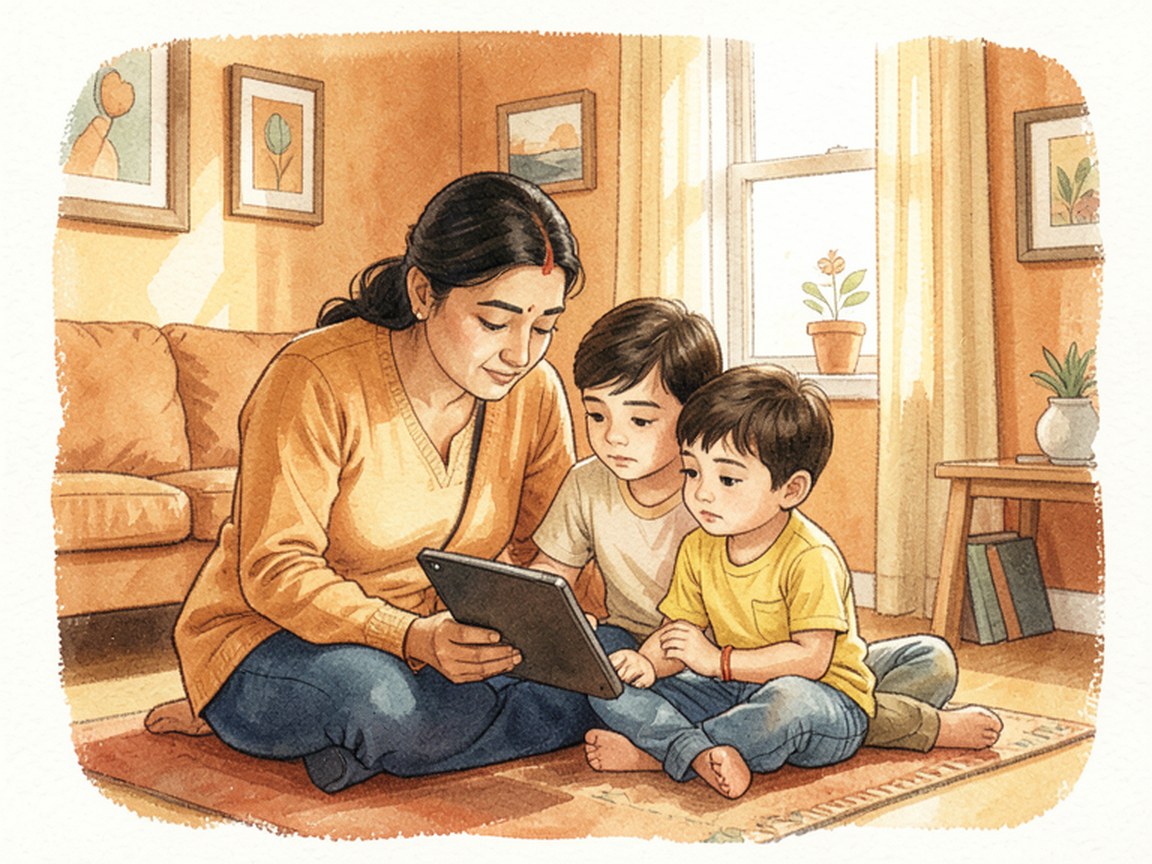
Whether children should use AI has largely been overtaken by events — most already do. The more useful question is what they use it for. AI used to skip the thinking weakens exactly the capacity school is meant to build, while AI used to check, argue with, or extend a child's own thinking can strengthen it. As a parent, your work is learning to tell those two apart.
Read this first
One thing that isn't a programme question. If your child's use of a chatbot or online space has moved into something that worries you for their safety — a relationship that feels wrong, contact from a stranger, or distress you can't place — that isn't something to work through over months. Speak to your child directly, involve the school or the relevant authorities where warranted, and where there is any risk of harm, act on it now. Please don't wait for a session.
How this changes as they grow.
Age 6
Homework comes back suddenly, suspiciously polished — and you don't know how to raise it.
Age 9
Your child asks an AI something they'd once have asked you, and you notice the shift.
Age 12
You can't decide whether to ban it, allow it, or teach it — so nothing gets decided.

Age 14
The school has no coherent policy, and every parent you ask is guessing too.

Age 16
You lie awake wondering which skills will still matter to your child in fifteen years.

Now
Your child is forming something like a relationship with a chatbot, and you're not sure what to make of it.
Swipe through the day
For a few years the parenting conversation about AI was stuck on whether children should use it at all. That debate is largely over — not because anyone won it, but because the technology arrived in your child's schoolwork, their phone, and their conversations before most households had a chance to decide. Ask any class of teenagers and you'll find the tools are simply there, the way search engines were there for the generation before.
So the question that actually earns your attention is a different one. Not whether your child uses AI, but what they use it for. Those are not small variations on a theme. They lead to opposite outcomes.
An AI used to produce the essay your child was meant to learn to write has quietly removed the very struggle the assignment existed to create. An AI used to check that essay, to argue against it, to find the weak paragraph — that has added a second mind to your child's own. Same tool, same afternoon, entirely different effect on the person your child is becoming. This programme is built around learning to see that difference, and to shape which one is happening in your home.
You don't need to understand how these systems are built to parent well around them, any more than you needed to understand internal combustion to teach road sense. But you do need one accurate mental model, because the wrong one leads to the wrong worries.
Here is the usable version. These systems are pattern-completion engines. They have read an enormous amount of text and learned, with remarkable skill, to produce the words that plausibly come next. What they do not have is understanding. They do not know whether what they've said is true. This is why they can write a fluent paragraph about your child's syllabus and confidently include a fact that is simply wrong, delivered in exactly the same assured tone as the facts that are right.
Hold on to that: fluency without understanding, confidence without knowledge. It explains almost everything a parent needs to watch for. It's why the tool is genuinely useful for some tasks and quietly dangerous for others. And it's why the most important thing your child can learn is not how to use it, but how to doubt it.
If there is one idea worth taking from this entire programme, it is the distinction between offloading the thinking and offloading the drudgery.
Some of what a task demands is the point of the task. When a child works through a maths problem, the working is the learning; the answer is almost incidental. When they write an argument, the wrestling with how to say it is where the thinking gets built. Hand those parts to a machine and you haven't saved effort — you've removed the thing the effort was for.
But not everything in a task is like that. Formatting a bibliography, finding five sources to then read properly, cleaning up grammar in a language that isn't the child's first, generating practice questions to then attempt honestly — this is drudgery around the thinking, not the thinking itself. Handing that over can clear a child's attention for the harder part.
The whole difficulty is that the line between the two is not fixed. It moves with the child's age, the subject, and what a particular task was designed to build. A tool that's a crutch for a nine-year-old learning to write can be a legitimate aid for a sixteen-year-old who already can. This will not give you a rule you can print and stick on the fridge, and any programme that promised to would be lying — because the judgement is the skill. What it will give you is the practice of seeing that line clearly in your own child's real work, week after week, until reading it becomes second nature.
For a long time, the scarce skill was finding information. That era is ending. When a machine will confidently hand you an answer to almost anything, the scarce skill becomes knowing whether to believe it.
This is why verification, not prompting, is the literacy that matters most. A child who assumes the confident answer is correct is in more danger than a child who never touched the tool at all, because they've gained speed and lost doubt in the same motion. The child you want to raise is one who instinctively asks: how would I check this? Is this the kind of thing it tends to get wrong? Does this actually make sense?
That instinct isn't taught in a lecture. It's built by watching a parent do it, again and again, in ordinary moments — checking a date, questioning a claim, arguing with the machine out loud at the kitchen table. Over the programme we work on making verification a family habit rather than a rule, precisely because a habit travels. It goes with your child into the exam hall, into arguments with friends, into a working life you can't yet picture — to all the places where you won't be standing beside them.
Most of what's written about children and AI is written for Western homes and Western schools. That's a real problem here, and it runs deeper than accent.
Consider the exam-oriented system your child is actually in. When education is organised around high-stakes tests, an AI-assisted shortcut carries an immediate, visible payoff — a better mark this week — and a delayed, invisible cost: the capacity that didn't get built. That trade is far more tempting in a coaching-class culture optimised for results than in a system with more room to fail and learn. A parenting approach imported from elsewhere simply doesn't see this pressure, because it wasn't built to.
Then there is your own use. Many parents reading this use AI at work every day, which means your child is learning from how you use it long before any conversation about how they may. That modelling is an asset, if you're deliberate about it, and this programme treats it as one.
And there is a pointed irony worth naming. Most AI systems, asked a parenting question, answer with quietly Western assumptions baked in — about joint families, about how our schools and exams work, about what a household even looks like. As an AI-native company that works specifically with Indian parents, this is the exact gap we exist to close. It's the one topic where being who we are gives us something to say that a general tool can't.
The last stretch of the programme turns from the tool to the child, and to a harder question: given a technology that keeps changing, what should you actually build in your child?
Nobody knows the future with confidence, and it's worth being honest that any parenting claim resting on certainty about fifteen years from now is worth very little. But some bets are more reasonable than others. The capabilities that look hard to automate — judgement, taste, the patience to sit with a difficult problem instead of reaching for the quick answer, the relational skill that no model has — plausibly grow more valuable as the routine work gets cheaper, not less. Those are the things worth protecting and growing, in the quiet, unglamorous ways that actually work in a home.
You won't leave this programme with your child's future settled, because it isn't yours to settle. You'll leave with something more durable: a clear view of what your child uses these tools for, a household position you've actually thought through rather than defaulted into, a verification habit you can pass on, and a considered sense of what to protect in a person growing up in a world you can't fully predict. That is the real work of parenting in this age — not controlling the technology, but knowing your own mind about it.
Sit with your child and ask them to show you what they actually use AI for — not to catch them out, but genuinely to see. Most parents are surprised in both directions: some uses are more thoughtful than feared, others more of a shortcut than admitted.
Take one answer an AI gave — a date, a fact, a piece of homework — and verify it out loud, together. The point isn't the answer. It's that your child watches you treat a confident machine as something to be checked rather than believed.
Do a real task with AI while your child watches you think — where you push back, where you keep your own judgement, where you decide it's wrong. Modelling how you use it teaches more than any rule about when they may.
That helps in the moment. Changing the pattern takes something else.
A twelve-month programme on the technology already sitting in your child's schoolwork and conversations, built for the Indian home rather than borrowed from a Western one.
We start with a plain, usable picture of what these systems are — pattern completion that produces fluent, confident answers with no understanding underneath, which is why they can be so useful and so wrong in the same breath. Then we build an honest map of your own child's use: what they reach for it for, where it's already woven into schoolwork, and where the worry is real versus imagined.
This is the heart of the programme. There is a difference between using AI to skip the thinking a task was meant to build, and using it to clear away drudgery so the thinking can happen. That line is the whole issue, and it moves with the child's age and the subject. We work on seeing it clearly in your child's real assignments, so you can respond to a specific case rather than a general fear.
The single most important new literacy is not prompting — it's checking. A child who assumes the confident answer is correct is in more danger than one who never used the tool. We build verification into the ordinary rhythm of the household: how to question a source, how to notice a confident error, how to argue with a machine, so it becomes a habit your child carries into an exam hall where you aren't present.
We turn to the capabilities that plausibly grow more valuable rather than less — judgement, taste, the patience to sit with a hard problem, the relational skill no model has — while being honest that nobody knows the future with certainty. You leave with a considered household position, and a sense of what to protect and grow in your child over the years this technology keeps changing.
Small group — deliberately. Few enough that everyone is known, and no one is a spectator.
Message us to hear about dates, structure and fees for the next cohort.
Purnam is an AI-native parenting companion for modern Indian families. A structured programme, a smart companion that knows your family, and a small, honest community of parents — built to take you from surviving the day to thriving across the years.
Parenting that hasn't been handed down — for the generation that wants to parent differently than they were parented, but has no cultural template for it.
Purnam · our positioning
Purnam is built by a founding team with 18+ years across big tech, startups, and growth-stage technology companies — and, more to the point, by parents currently inside the early-childhood years themselves.
Parents to a toddler ourselves — building Purnam to help Indian families move from surviving to thriving.
Purnam's approach draws on modern developmental psychology — attachment, emotional regulation, behavioural coaching — held alongside Indian contemplative traditions as practical tools rather than belief.
We are advised by senior practitioners in human transformation and behavioural coaching. Where the evidence for something is strong, we say so. Where it is contested, we say that too.
Message us on WhatsApp about Growing Up With AI — dates, structure, fees, and whether it fits your situation.
Or just ask your actual question. That's what the line is for. Someone from the Purnam team will get back to you.
Purnam offers parenting support and education. This is not paediatric, medical, or mental-health treatment, and it is not a substitute for care from a qualified professional. Every child and family is different; nothing here is a promise of any particular outcome.