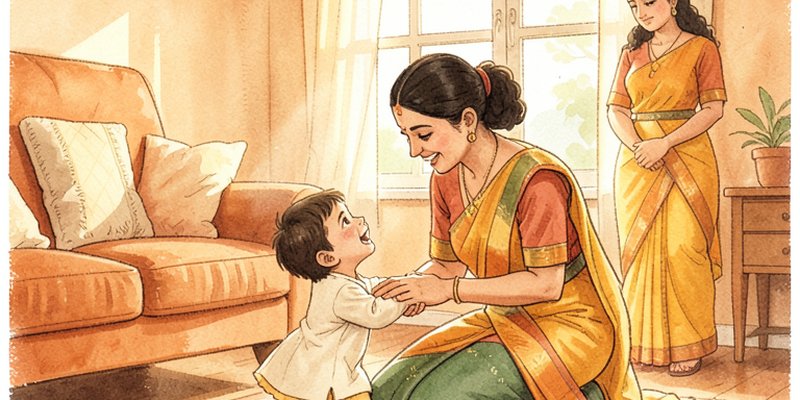
Monday
You said no to the sweet, and it was in your child's hand within the minute.
Parenting in a Joint Family ·3 months ·All ages
When an elder hands over the sweet right after you said no, the child isn't the problem and the sweet isn't the point. The question underneath is who gets to decide — in a house where that was never explicitly agreed. This is a focused programme on setting boundaries that hold, without declaring war at home.

The conflict is rarely about the biscuit or the bedtime. It's about authority — who gets to decide, in a house where that was never explicitly agreed. Boundaries hold better when they're set between the two of you first and communicated by the person whose family it is, rather than negotiated live in front of the child.
Read this first
One thing that is not a boundary-negotiation matter. If there is abuse in the home, or you have any concern about your child's physical or emotional safety, that is not something to work on over three months. Do not treat it as a disagreement to be managed. Act directly to protect your child, and seek professional and legal help now. Please don't wait for a programme.
One ordinary week in a joint household.
Monday
You said no to the sweet, and it was in your child's hand within the minute.

Tuesday
You were corrected in front of your child — gently, lovingly, and completely undermining what you'd just said.

Wednesday
"We raised four children and nothing happened to us" — offered as the end of the discussion.
Thursday
Your spouse went quiet instead of backing you, and you were left holding the rule alone.

Friday
You were called rigid, modern, or Western simply for having a rule and keeping it.

Saturday
A screen appeared to stop a tantrum you were already handling, and now the tantrum is about the screen.
Swipe through the day
Stand in almost any joint-family kitchen at the wrong moment and you'll see the same scene. A parent says no. An elder, smiling, hands the thing over anyway. The parent's face tightens. Nothing is said, because something is always cooking and someone is always watching.
It is tempting to read this as a fight about sweets, or screens, or bedtime. It almost never is. Underneath the biscuit is a question nobody in the house has ever asked out loud: who gets to decide? In a home where three or four adults are raising one child, that question has an answer — but usually an unspoken, contested, shifting one. The friction you feel at the kitchen counter is that unsettled question surfacing, one small decision at a time.
This matters because you cannot solve a question of authority by arguing about biscuits. You can win the biscuit and lose the war, or concede the biscuit and still be nowhere, because the thing actually in dispute was never on the plate.
When two parents disagree, they are, at least in principle, on level ground. They can hash it out as equals and land somewhere. The disagreement in a joint home is not shaped like that, and pretending it is produces advice that doesn't work.
Three things make it different. The first is a cultural-authority overlay: in many Indian families, age itself carries the right to decide, and an elder's opinion about a child isn't offered as one view among several — it arrives with the weight of position behind it. The second is a genuine generational gap in parenting norms. The people handing over the sweet raised their own children in a different world, often successfully by the measures they had, and they are not being difficult when they trust what worked for them. They are being consistent.
The third is the one least often said plainly. For a daughter-in-law especially, there is a structural power imbalance built into the household itself — she is holding a rule inside a home, and sometimes a family, that was not originally hers, frequently without her spouse standing clearly beside her. That is not a small emotional wrinkle to be reframed away. It is a real feature of the situation, and any approach that ignores it will ask her to do something the structure won't let her do.
None of this makes the elders adversaries. It makes the terrain uneven. The work is to parent well on uneven ground, not to pretend the ground is flat.
Here is a distinction worth holding carefully, because getting it wrong poisons the whole house.
Most of the time, an elder who overrides you is not undermining you. They are loving your child in the way they know, on instincts formed decades ago, usually without any strategy against you at all. The grandmother with the extra sweet is not running a campaign. She is being a grandmother, doing the thing grandmothers in her world have always done.
Treating that as sabotage is a serious error. It turns a difference in style into a matter of loyalty, and it makes every small moment a referendum on respect. The home hardens. Nobody backs down, because now backing down means admitting to something they never intended.
But — and this matters too — occasionally it genuinely is undermining. There are homes where the contradiction is pointed, where a rule is broken precisely because it was yours, where the message to the child is deliberately that you don't really decide here. That is a different problem, and it needs naming rather than smoothing over. Part of the early work is telling these apart honestly, because the response to loving-differently and the response to being-undermined are not the same, and using one where the other is needed makes things worse.
You cannot hold thirty boundaries in a shared house. You will exhaust your standing, wear out everyone's patience, and lose the few that count in the noise of the many that don't.
So the discipline is to sort. A small number of things genuinely matter for how a child develops — how consistently their world responds, whether difficult feelings get met or switched off with a screen, whether the same behaviour brings the same result from the adults who matter most. A far larger number of things are simply your preference: the timing of a snack, a particular food, a way of dressing, the hundred texture-of-the-day decisions that feel enormous in the moment and vanish in a year.
Choosing your three non-negotiables is not surrender. It is what makes the three defensible. When you hold everything with equal intensity, an elder cannot tell your principles from your moods, and neither can your child. When you hold three things steadily and let the rest go with genuine grace, the three acquire weight — and, often, the elders start to respect them, because it's clear they aren't arbitrary.
If there is one structural move that changes joint-family conflict more than any other, it is this: the person whose parents they are does the talking.
If the disagreement is with your mother, you raise it — not your spouse. If it's with your mother-in-law, your spouse does, not you. The reason is not etiquette. It is that a boundary raised by a blood relative lands as a family conversation, while the same words from the in-law land as a challenge from an outsider, no matter how gently they're put. The identical sentence carries completely different weight depending on whose mouth it comes from.
This is why aligning with your spouse first isn't one step among several — it's the whole foundation. If the two of you are not saying the same thing in private, the blood-relative rule has nothing to carry. But once you are genuinely aligned, and the message to each set of parents comes from their own child, most of what felt impossible becomes merely difficult. The daughter-in-law stops being the one holding a lonely line against a house that outranks her. The line becomes the couple's, spoken into each family by the person that family will actually hear.
That is the shift this programme is built around. Not a script for winning arguments, but a way of setting boundaries between the two of you first and communicating them through the person whose family it is — so that what holds your child's world steady is an agreement, not a standoff.
The person whose parents they are does the talking. If it's your mother handing over the sweet, you raise it with her — not your spouse, and never in front of the child. It sounds like a small reallocation. It changes who the conversation is between, and that changes everything about how it lands.
Whatever you disagree about, take it out of the room. In the moment, hold the line quietly or let it pass, and settle it privately afterwards. A child who watches two adults contest a rule learns that rules are negotiable and that adults can be played against each other. Neither is what you want them learning.
Write down the three things that genuinely matter to you — the ones you'd hold even at the cost of friction. Then consciously let the rest go. Most of the daily friction in joint homes comes from treating a preference as a principle. Deciding in advance which is which is most of the work.
That helps in the moment. Changing the pattern takes something else.
Three months on the disagreement that runs quietly under most joint and extended-family homes in India — not who is right about screens or sweets, but who decides, and how you make that hold without rupture.
Before changing anything, we build an honest picture of how decisions actually get made in your home — who defers to whom, where you have standing and where you only think you do, and which flashpoints are really about the child versus really about position in the household. Most couples find the map is not the one they assumed they were living on.
Nothing holds if the two of you aren't saying the same thing. This is the phase most couples skip and most boundaries fail on. We work on getting genuinely aligned in private — not a grudging truce, but an actual shared position — and on what to do when your spouse's instinct is to keep the peace by going quiet.
The specific language for raising something with an elder without disrespect and without retreat. How the blood-relative rule shapes who speaks. What to say to "we managed fine in our day." How to hold a line while keeping the warmth intact — because the goal is not to win, it's to be able to keep living together well.
A boundary set once and never maintained quietly dissolves. This phase is about the long game — absorbing the tests, staying steady when a rule is probed, repairing when a conversation goes badly, and adjusting as your child grows and the terrain shifts. The aim is a home that runs on a settled understanding rather than a recurring argument.
Small group — deliberately. Few enough that everyone is known, and no one is a spectator.
Message us to hear about dates, structure and fees for the next cohort.
Purnam is an AI-native parenting companion for modern Indian families. A structured programme, a smart companion that knows your family, and a small, honest community of parents — built to take you from surviving the day to thriving across the years.
Parenting that hasn't been handed down — for the generation that wants to parent differently than they were parented, but has no cultural template for it.
Purnam · our positioning
Purnam is built by a founding team with 18+ years across big tech, startups, and growth-stage technology companies — and, more to the point, by parents currently inside the early-childhood years themselves.
Parents to a toddler ourselves — building Purnam to help Indian families move from surviving to thriving.
Purnam's approach draws on modern developmental psychology — attachment, emotional regulation, behavioural coaching — held alongside Indian contemplative traditions as practical tools rather than belief.
We are advised by senior practitioners in human transformation and behavioural coaching. Where the evidence for something is strong, we say so. Where it is contested, we say that too.
Message us on WhatsApp about Parenting in a Joint Family — dates, structure, fees, and whether it fits your situation.
Or just ask your actual question. That's what the line is for. Someone from the Purnam team will get back to you.
Purnam offers parenting support and education. This is not paediatric, medical, or mental-health treatment, and it is not a substitute for care from a qualified professional. Every child and family is different; nothing here is a promise of any particular outcome.