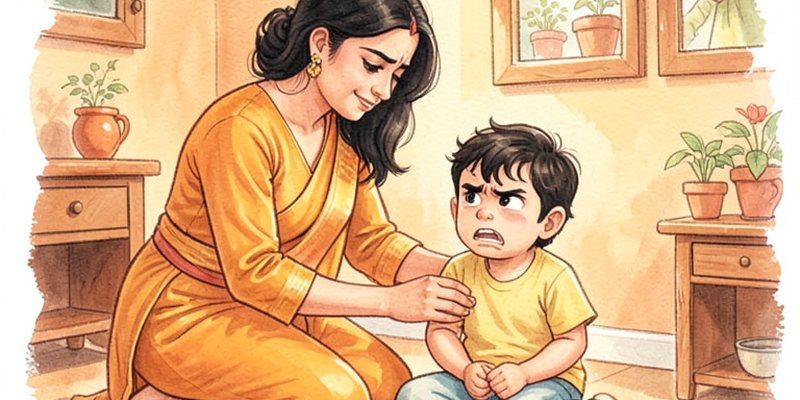
Minute 0
The supermarket floor, in front of strangers, and everyone has an opinion on your face.
The Hard Moments Program ·1 month ·18 months – 5 years
The fastest way through a meltdown is not a better argument — it's a calmer adult. This is a focused one-month programme on what to actually do in the moment, on the flashpoints specific to your house, and on repairing when you get it wrong.

A tantrum is not misbehaviour — it's a nervous system that has run out of capacity. The fastest way through one is to lower your own volume before you lower theirs: get to eye level, name what you see in five words or fewer, and stop explaining. Explanations land after the storm, never during it.
Read this first
One thing that is not a programme matter. If a child is being hurt — by anyone — or if you are frightened of your own reactions, please do not wait a month for a session. That is not something to work through over four weeks; it is something to act on now. Speak to someone today, and seek a paediatrician or a qualified professional. Reaching for help early is not a failure of parenting — it is one of its steadier acts.
How one hard moment actually unfolds.
Minute 0
The supermarket floor, in front of strangers, and everyone has an opinion on your face.

Minute 2
The shoe that must go on the wrong foot, and the world ends when it doesn't.

Minute 5
A bedtime negotiation that turns into a forty-minute fight neither of you wanted.
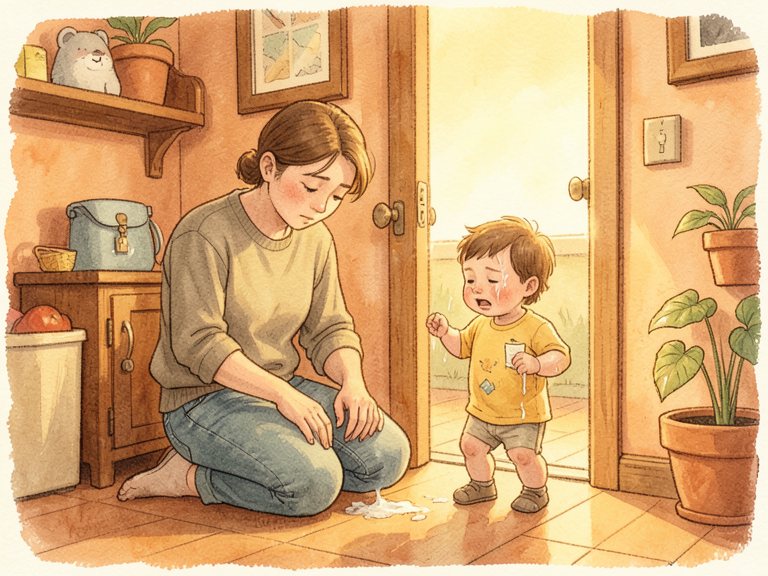
Minute 9
The meltdown that arrives the moment you get home from work, with nothing left in your own tank.

After
It happens in front of your mother-in-law, who is watching, and saying nothing, which is worse.
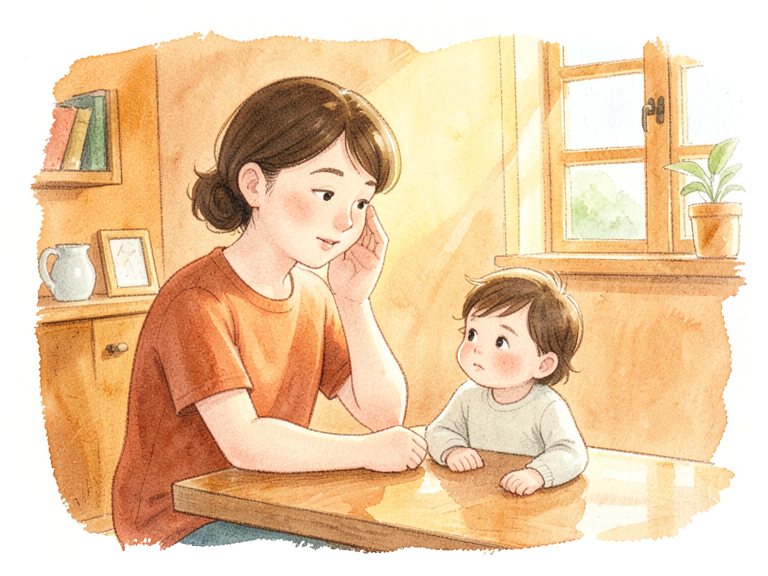
Later
The moment you hear your own parent's voice come out of your mouth, and you don't recognise it.
Swipe through the day
Start with a reframe, because everything else follows from it.
When a two-year-old comes apart over the wrong-coloured cup, it is tempting — and, in most households, automatic — to read it as defiance. As a child who has learned they can push, and is pushing. As something to be managed, out-stubborned, waited out until they learn.
That reading is almost always wrong, and it is the reason so much tantrum advice fails. A meltdown is not a strategy. It is a nervous system that has run out of capacity to hold what it's holding — the disappointment, the tiredness, the hunger, the too-muchness of an ordinary Tuesday — and has tipped over the edge of what it can regulate on its own.
This matters practically, not just philosophically. If a tantrum is defiance, the sensible response is to win: hold firm, don't reward it, show them who's in charge. If a tantrum is an overwhelmed system, that response pours fuel on it, because you're bringing force to a child who has already lost the ability to meet force with anything but more overwhelm. The two readings lead to opposite hands on the same moment. Getting the reading right is most of the work.
There is a reason these particular years are so loud.
Between roughly eighteen months and five, a child's capacity to feel is developing far faster than their capacity to manage what they feel. The wanting, the fury, the grief over a dropped biscuit — all of it arrives at full volume, into a brain whose braking system is years from finished. They are not choosing to be unreasonable. They are, quite literally, not yet equipped to be reasonable in the moments that most demand it.
What developmental science broadly describes is a gap — big feelings, small regulator — and that gap is widest precisely in the toddler and preschool years. This is why the same child who negotiates like a diplomat at breakfast dissolves completely at bedtime. It isn't inconsistency or manipulation. It's a system that has capacity in the morning and none left by night.
Understood this way, the years stop being a problem to survive and become a window to work with. The child is not broken and does not need fixing. They are doing exactly what this age does — and what they need from you is not correction but a steadier nervous system to borrow while theirs is still being built.
Here is the part that surprises people, and the part the whole programme turns on.
The most powerful tool in the room during a meltdown is not a technique you apply to the child. It is your own state. A young child in overwhelm regulates by borrowing calm from a nearby adult — this is not a metaphor, it is close to how the developing system actually works. Your steadiness is contagious. So, unfortunately, is your escalation.
Which means the intervention is mostly you. When you get low and quiet, when your own heart rate comes down, when you stop arguing and simply stay — you are handing the child something their own brain cannot yet generate. When you match their volume, you confirm to their system that the situation is indeed an emergency, and you both go over the edge together.
This is why 'how do I handle tantrums without yelling' is really two questions wearing one coat. The child's meltdown is one. Your own — the surge of heat when the whining starts, the exhaustion at the end of a long day, the flush of shame when people are watching — is the other. And of the two, yours is the one you can actually change. So that is where we start: not with a script for the child, but with the ninety seconds inside you before the words come out.
None of this happens in a vacuum. It happens in a specific kind of home, and three forces make it harder here than the tidy advice acknowledges.
The first is the audience. In a joint family, a meltdown is rarely private. There are grandparents in the next room, a didi in the kitchen, neighbours across the balcony — and a tantrum becomes a performance you are being graded on in real time. The steadiness the moment requires is exactly the thing an audience makes hardest to summon. You are not only regulating a child; you are managing the eyes.
The second is the shame layer. Somewhere underneath the noise sits a quiet fear of being judged — an indulgent parent, a mother who can't control her child, someone who has let the child become 'spoilt'. That fear pushes you toward the loud, visible correction that proves to the watchers you are Doing Something, and away from the quiet steadiness that actually works. The performance for the audience and the thing the child needs point in opposite directions.
The third is the deepest. Most Indian parents of this generation were disciplined into silence rather than through it. A raised voice, a slap, a threat, a withdrawal — the meltdown was ended, not met. So when your own child comes apart, you reach for the only thing that was ever modelled for you, and are startled to hear your parent's voice arrive in your mouth. This is not a character flaw. Nobody showed you another way, because the way we are describing was not in the room when you were small. Part of what this month is for is building the thing that was never handed to you — slowly, and without shame that you didn't have it already.
To be honest about the scope: four weeks will not end tantrums, and any programme that promises to would be lying to you. Tantrums are the weather of these years, and the years arrive whether or not anyone is ready.
What a month can do is change how the storms are met. You leave with a protocol you can run when your own thinking has narrowed. You leave with your specific flashpoints named and planned for, rather than met by surprise each evening. And you leave with a way back — the repair that turns a moment you handled badly into one that ends up, oddly, building trust rather than eroding it. The goal was never a child who never melts down. It was a parent who is no longer undone when they do.
During a meltdown, most of us reach for a paragraph. A child in that state can't process a paragraph. Say what you see, short and flat: 'You wanted the blue cup.' That's the whole sentence. Naming what's happening does more to settle a nervous system than any reason you could offer.
Get physically low — kneel, sit, get under their eye line rather than over it. A body that towers reads as a threat to a system already overwhelmed. The drop to eye level changes the encounter before you've said a word, and it does something to your own state too.
Repair is a thing you do once the storm has passed, not during it. Later, when you're both calm: 'That was hard. I'm here. We're okay.' One sentence. The explanation you were desperate to deliver mid-tantrum lands now, because now there is someone home to receive it.
That helps in the moment. Changing the pattern takes something else.
One month on the moments that undo you — the supermarket floor, the bedtime fight, the meltdown the minute you walk in the door — and on the one variable in the room you can actually change.
We start with you, not the child. Which moments reliably tip you over — the whining, the public eye, the end of a long day — and what your own body does in the seconds before you react. You can't regulate a child from a place you haven't noticed you've left. Most parents find their real work is here, in the ninety seconds before the words come out.
A simple, repeatable sequence you can run when your own heart rate is up and thinking is hard: lower your body, name it short, stop explaining, stay. We rehearse it until it's available to you under pressure rather than only in theory — because the moment it's needed is precisely the moment clever advice evaporates.
Not tantrums in general — yours. The bedtime one, the getting-out-the-door one, the screen-off one, the sibling one. We take your three most frequent hard moments and build a plan for each, because a strategy that isn't shaped to your actual evenings won't survive them.
You will get it wrong — everyone does, and the goal was never to stop. What matters far more is what happens after: the repair, and how it's done. We work on the language of coming back, on doing it without collapsing into guilt or over-explaining, and on why the moments you handle badly and then mend can matter as much as the ones you get right.
Small group — deliberately. Few enough that everyone is known, and no one is a spectator.
Message us to hear about dates, structure and fees for the next cohort.
Purnam is an AI-native parenting companion for modern Indian families. A structured programme, a smart companion that knows your family, and a small, honest community of parents — built to take you from surviving the day to thriving across the years.
Parenting that hasn't been handed down — for the generation that wants to parent differently than they were parented, but has no cultural template for it.
Purnam · our positioning
Purnam is built by a founding team with 18+ years across big tech, startups, and growth-stage technology companies — and, more to the point, by parents currently inside the early-childhood years themselves.
Parents to a toddler ourselves — building Purnam to help Indian families move from surviving to thriving.
Purnam's approach draws on modern developmental psychology — attachment, emotional regulation, behavioural coaching — held alongside Indian contemplative traditions as practical tools rather than belief.
We are advised by senior practitioners in human transformation and behavioural coaching. Where the evidence for something is strong, we say so. Where it is contested, we say that too.
Message us on WhatsApp about The Hard Moments Program — dates, structure, fees, and whether it fits your situation.
Or just ask your actual question. That's what the line is for. Someone from the Purnam team will get back to you.
Purnam offers parenting support and education. This is not paediatric, medical, or mental-health treatment, and it is not a substitute for care from a qualified professional. Every child and family is different; nothing here is a promise of any particular outcome.