18:30
The endless loop of water, then toilet, then one more story, then water again — and you can feel it happening but can't seem to stop it.
The Long Goodnight ·1 month ·2 – 10 years
If bedtime takes two hours and ends with your child asleep on you, tightening the rules usually makes it longer, not shorter. This is a focused programme on the one thing that actually shortens the evening: a predictable sequence, with connection front-loaded rather than bargained for.

Most bedtime resistance isn't about sleep — it's about separation and the end of the day's connection. A predictable sequence that includes a short window of undivided attention usually shortens bedtime more than tightening the rules does, because a child who has had you fully will let go of you more easily.
Read this first
One thing that isn't a routine problem. If your child's sleep has changed suddenly, if they snore heavily or seem to stop breathing, or if bedtime distress feels far beyond the ordinary, that belongs with your paediatrician before it belongs in any programme. A sequence can't fix something physiological, and it would be wrong to try.
Six moments from a single ordinary day.
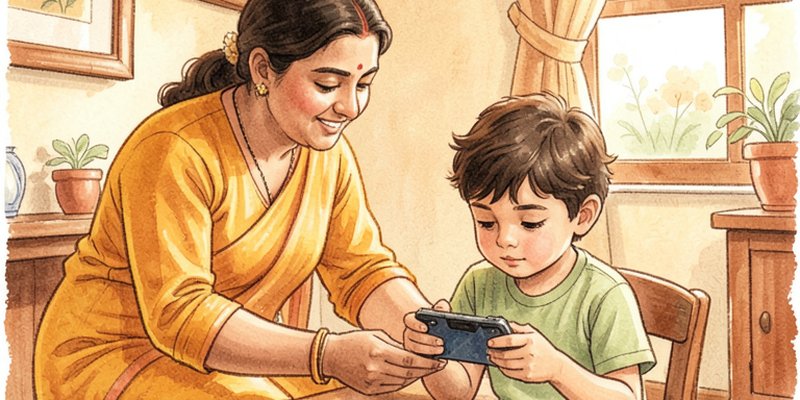
18:30
The endless loop of water, then toilet, then one more story, then water again — and you can feel it happening but can't seem to stop it.

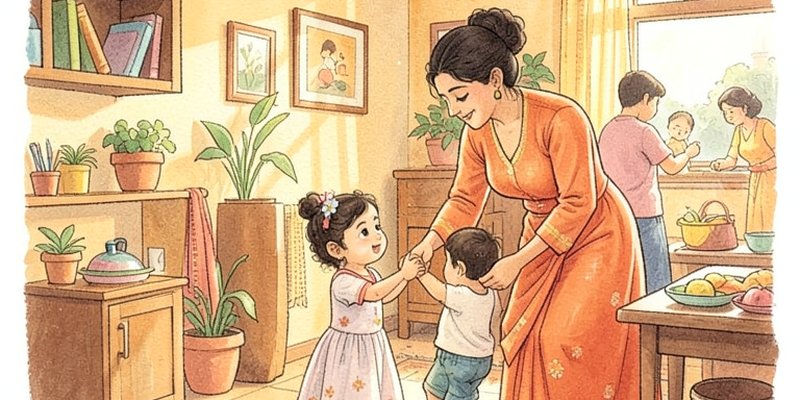
19:15
Two full hours from the first mention of bed to actual sleep, most of it spent negotiating.
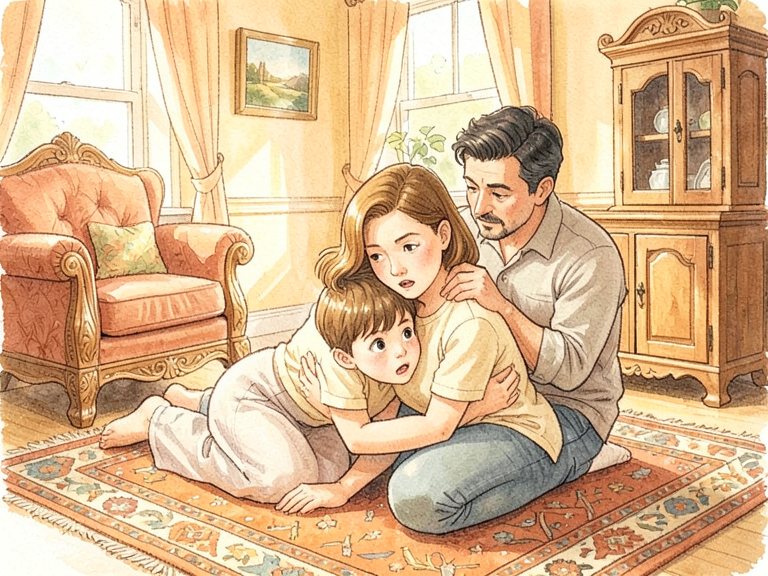
20:00
Your child only falls asleep on you, and the moment you shift your weight to leave, the eyes open.
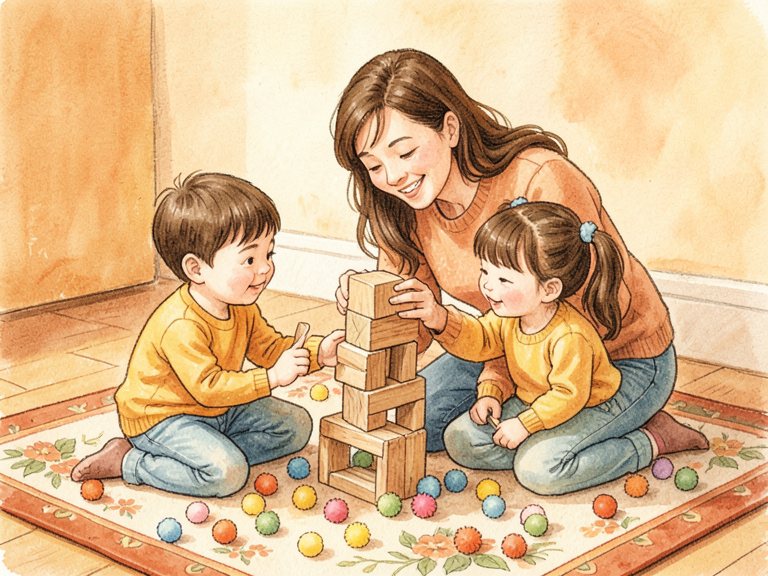
20:45
The evening you meant to have — the reading, the quiet, the ten minutes to yourself — is simply gone by the time they're down.
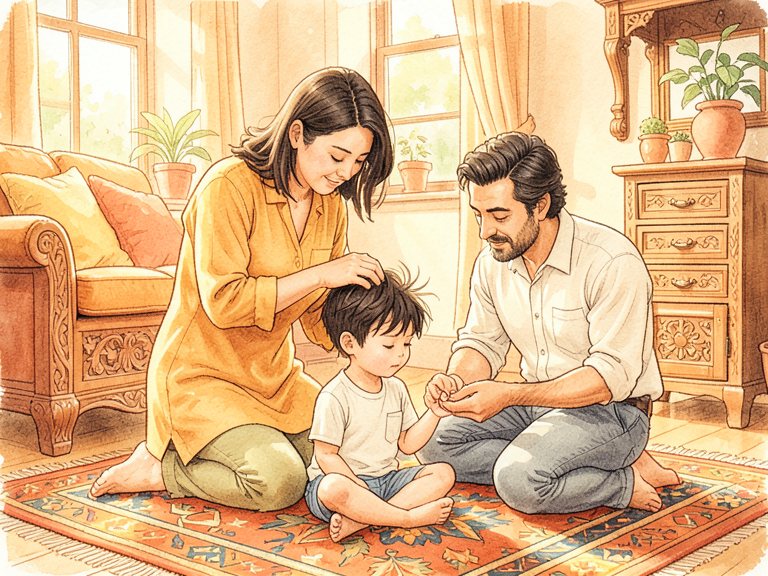
21:30
You've tried being firmer and you've tried being softer, and neither has changed the length of it.
Swipe through the day
Ask a tired parent what's wrong with bedtime and they'll describe a discipline problem. The child won't stay in bed. The child won't stop asking for things. The child won't fall asleep without being held. The natural response is to tighten up — be firmer, allow fewer requests, hold the line.
And then bedtime gets longer.
This is the pattern almost every family runs into, and it's the clue to what's really happening. Bedtime is not, for a young child, primarily about sleep. It is about separation. It is the moment the day ends, the adults withdraw, and the child is left alone in the dark with the loss of your company. Everything that looks like stalling — the water, the extra story, the sudden urgent thought — is a child trying to hold on to the connection a little longer.
Once you see it that way, the firmness paradox makes sense. Tightening the rules doesn't reduce the child's need to stay connected; it just removes the gentle ways of meeting it and leaves the desperate ones. The bargaining gets more inventive, not less.
The single most useful change most families make is not a rule. It's a sequence.
A bedtime sequence is the fixed order of the last stretch of the evening — the same steps, in the same order, every night. Bath, then milk, then teeth, then two books, then lights, then a specific goodnight. What the steps are matters less than that they never change.
Sameness is the active ingredient, and it works because of how a young child's sense of safety operates. Predictability is calming in a way that's almost physical. A child who knows exactly what comes next doesn't have to negotiate each step, because there's nothing to negotiate — the order is settled, the way sunrise is settled. Negotiation only makes sense when the outcome is still open. Close the outcome and the bargaining loses its point.
This is also why a sequence beats willpower. You will not out-argue a determined four-year-old at 9.45 at night, and you shouldn't have to. The structure does the arguing for you.
Here is the part that surprises parents most.
If separation is what drives the resistance, then the answer isn't to ration connection at bedtime — it's to give it early, deliberately, before the sequence even begins. Ten minutes of genuinely undivided attention, phone away, fully present, on the child's terms. Not as a reward for good behaviour, and not as a step to be earned, but as the thing that takes the pressure out of the whole evening.
A child who has had you fully will let go of you more easily. A child who has spent the day near you but not with you — which is most children, in most working households — will spend bedtime fishing for the connection they didn't get. And bedtime is a very good place to fish, because you're tired, because you want them asleep, and because "one more story" is hard to refuse.
Front-loading changes the economics of the evening. The connection that used to get extracted from you in twenty small negotiations gets given once, on purpose, at the start. It is almost always cheaper that way.
A sequence built for a quiet house at 7 p.m. is of no use to a family that sits down to dinner at 9.30, in a home with grandparents, cousins, a television, and a doorbell.
So we work with the evening you actually have. Late dinners are a genuine complication, not a failure of discipline — a meal at nine pushes a wound-up child into bed at exactly the wrong moment, and no amount of routine fixes the clock by itself. What can be protected is the wind-down around the meal, and the question of where the sequence can begin even when dinner is late.
Joint-family noise is the other reality. You cannot ask a whole household to fall silent for one child's bedtime, and you shouldn't build a plan that depends on it. What you can do is create a pocket of predictability inside the noise — a consistent room, a consistent order, a consistent goodnight — that holds even when the television doesn't switch off.
And co-sleeping deserves to be named plainly. Sharing a bed is not a problem to be fixed. It is ordinary across most of India and most of the world, and children raised this way are perfectly well. It's worth addressing only if it has become a problem for you — your rest, your back, your relationship. This programme helps you choose on purpose, either way, rather than arriving somewhere you never decided to go.
Families who get this right describe a similar shift. The evening stops being a two-hour campaign and becomes a sequence with an end you can see. The requests thin out, because they've been built into the routine instead of fought at the door. And the parent gets some of the night back — the reading, the quiet, the ten minutes that used to disappear.
What this will not do is end every hard night. Illness, travel, a new sibling, a bad dream, a visiting relative who winds everyone up — these will still produce difficult evenings, and any programme that promised otherwise would be lying to you. The goal is not a child who is asleep in ten minutes flat, every night, forever. The goal is to stop losing the whole evening to a fight you didn't understand, and to have a sequence solid enough that a bad night is just a bad night, not a return to square one.
Pick the order of the last forty minutes — bath, milk, teeth, two books, lights — and run it in exactly that order tonight and tomorrow and the night after. The predictability itself does more work than any single step in it. A child who knows what comes next stops negotiating each step.
Before the sequence starts, give ten minutes of undivided, phone-away, fully-present attention — on the floor, on their terms. Bedtime often stretches because it's the child's last bid for connection at the end of a day where they didn't get enough. Meet the bid early and the bargaining later tends to shrink.
That helps in the moment. Changing the pattern takes something else.
Four weeks on the evening you keep losing, and on the small structural change that gives most of it back — without cry-it-out, and without pretending co-sleeping is a problem you have to solve.
Before changing the routine, we look honestly at what bedtime is for your child. Separation, over-tiredness, an under-connected day, a genuinely late household — these produce very different evenings. Most parents have been treating a connection problem as a compliance problem, which is why firmness hasn't worked.
The specific, repeatable order of the last stretch of the evening, and why sameness is the active ingredient. We work out where the requests are actually coming from, why negotiation extends bedtime rather than ending it, and how to front-load connection so it isn't something your child has to fish for at 10 p.m.
A sequence only holds if the house lets it. We work on the real Indian evening: dinner that lands late, a joint family with its own rhythm, cousins and grandparents and a television that doesn't switch off when the child's does. How to protect the wind-down without demanding the whole house go silent.
Embedding the sequence so it survives a bad night, a holiday, or a visiting relative. What to do when it slips, how to think about the gradual shift out of falling-asleep-on-you if that is what you want, and how to decide — deliberately, not by default — what stays and what changes.
Small group — deliberately. Few enough that everyone is known, and no one is a spectator.
Message us to hear about dates, structure and fees for the next cohort.
Purnam is an AI-native parenting companion for modern Indian families. A structured programme, a smart companion that knows your family, and a small, honest community of parents — built to take you from surviving the day to thriving across the years.
Parenting that hasn't been handed down — for the generation that wants to parent differently than they were parented, but has no cultural template for it.
Purnam · our positioning
Purnam is built by a founding team with 18+ years across big tech, startups, and growth-stage technology companies — and, more to the point, by parents currently inside the early-childhood years themselves.
Parents to a toddler ourselves — building Purnam to help Indian families move from surviving to thriving.
Purnam's approach draws on modern developmental psychology — attachment, emotional regulation, behavioural coaching — held alongside Indian contemplative traditions as practical tools rather than belief.
We are advised by senior practitioners in human transformation and behavioural coaching. Where the evidence for something is strong, we say so. Where it is contested, we say that too.
Message us on WhatsApp about The Long Goodnight — dates, structure, fees, and whether it fits your situation.
Or just ask your actual question. That's what the line is for. Someone from the Purnam team will get back to you.
Purnam offers parenting support and education. This is not paediatric, medical, or mental-health treatment, and it is not a substitute for care from a qualified professional. Every child and family is different; nothing here is a promise of any particular outcome.