Monday
Your child spikes a fever at 2am and there is genuinely no one to call.
Parenting Without a Village ·6 months ·All ages
The extended household that once made Indian parenting workable has largely disappeared in the metros, and nothing replaced it. If you are carrying everything alone, in a city far from family, this is a programme on deliberately building the small support structure that used to arrive by default.
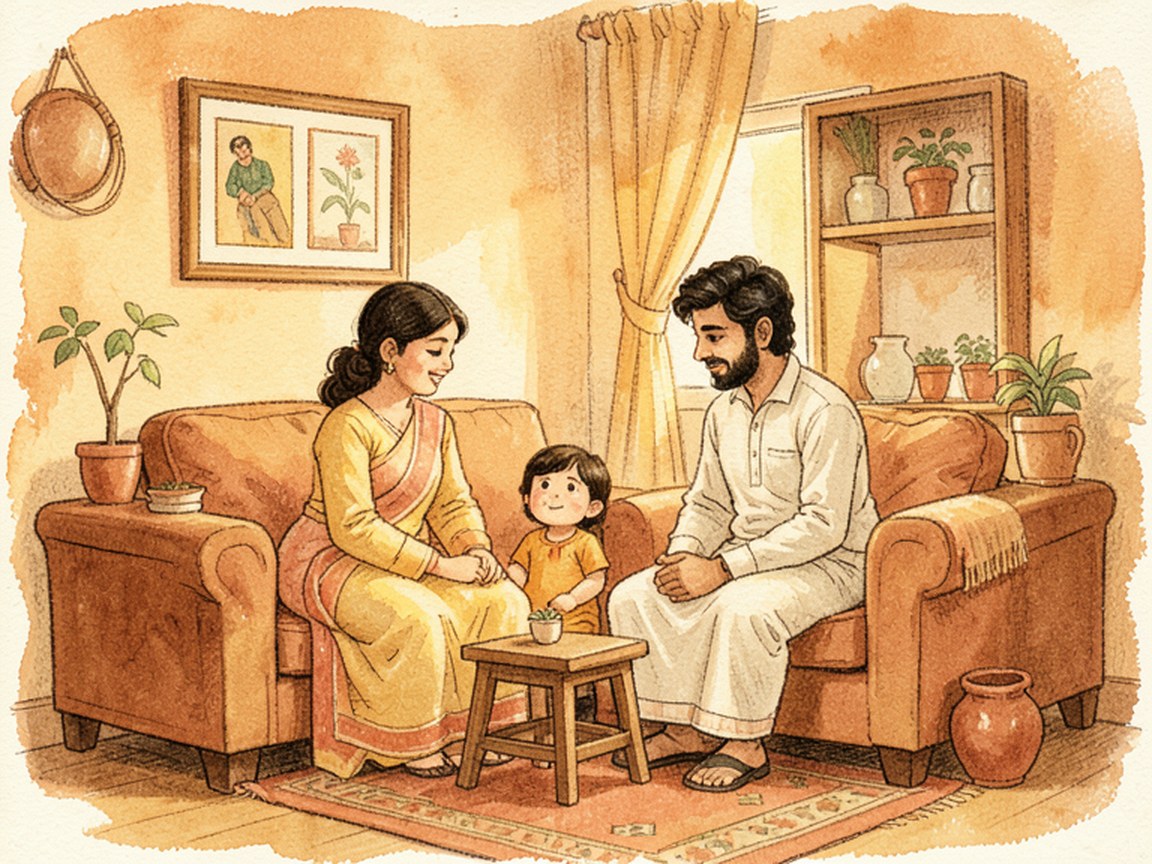
The isolation is structural, not personal — the extended household that made Indian parenting workable has largely disappeared in the metros, and nothing has replaced it. What helps is deliberately building a small, reciprocal support structure, because it no longer arrives by default. That means naming what you actually need and making real arrangements, rather than waiting to cope.
Read this first
One thing worth naming separately. Relentless isolation is exhausting, and exhaustion is normal. But if what you're carrying feels heavier than tiredness — a flatness or heaviness that doesn't lift even when you do get a break — that is worth speaking to a doctor or a counsellor about, not managing alone. Building a support structure helps a great deal; it is not a substitute for care when the load has tipped into something more.
One ordinary week in your house.
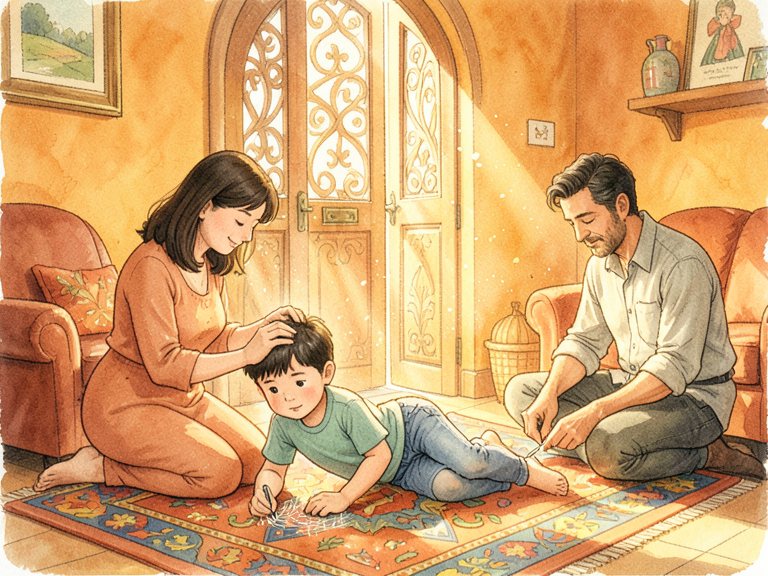
Monday
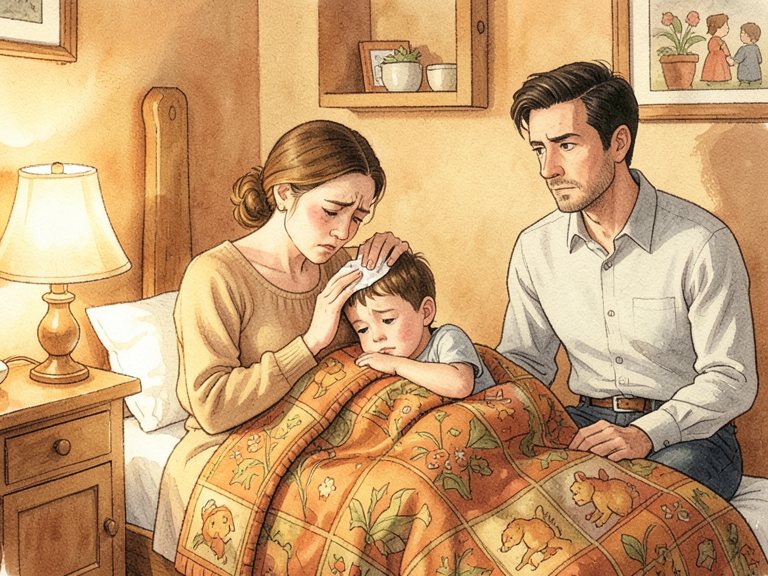
Your child spikes a fever at 2am and there is genuinely no one to call.
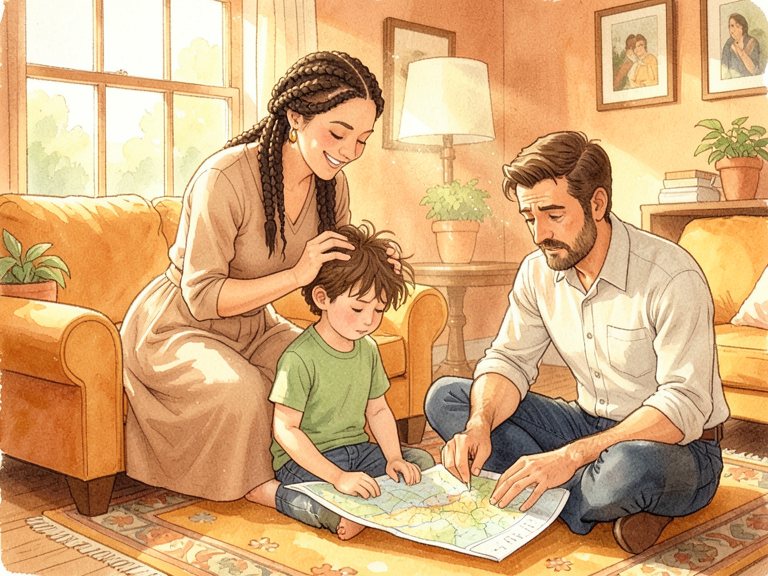
Tuesday
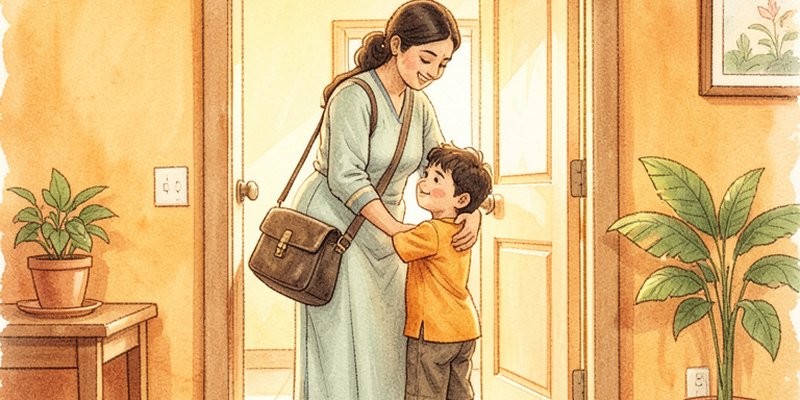
You cannot remember the last time you had two hours off — not to rest, just to be a person.
Wednesday
A new city, a good job, and not a single number you could ring in an emergency.
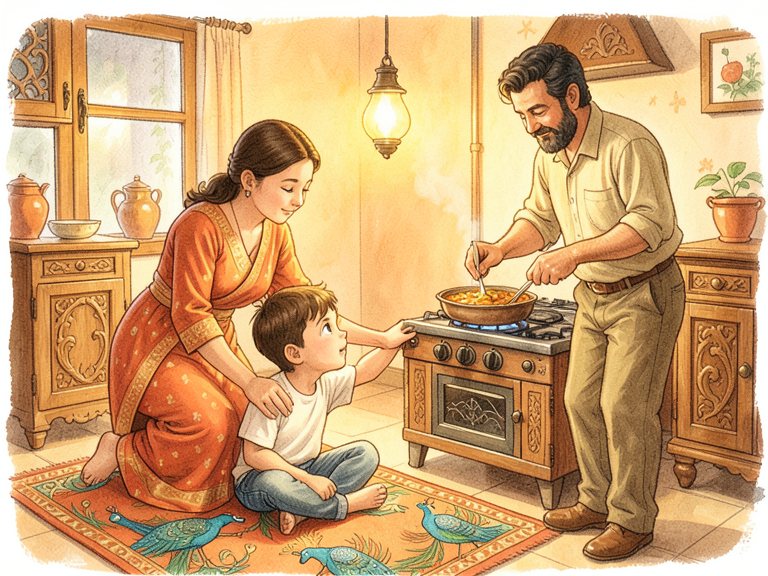
Thursday
You watch a friend's parents step in without being asked, and feel an absence you'd rather not admit to.
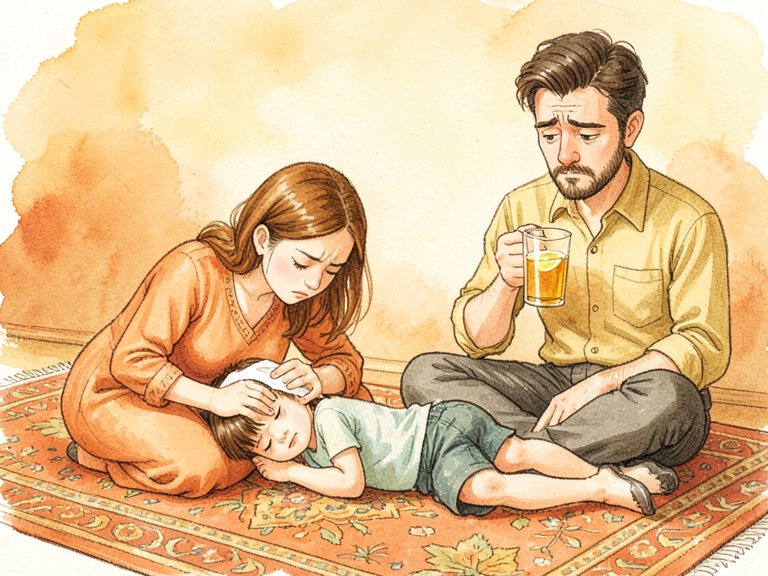
Friday
Both of you are ill at once, and the household simply has to keep running anyway.
Saturday
You need help, and some part of you is convinced that needing it means you're doing this wrong.
Swipe through the day
There is a particular loneliness to raising children in a city that isn't home. It doesn't always announce itself. It shows up in small moments — a fever at midnight and no one to call, a week where both of you are ill and the household simply has to keep running, the quiet arithmetic of realising you cannot name a single person who could take your child at an hour's notice.
It is easy to read that feeling as a personal failing. You should have made more friends. You should be coping better. Other people seem to manage. Almost none of that is true, and believing it makes the problem worse.
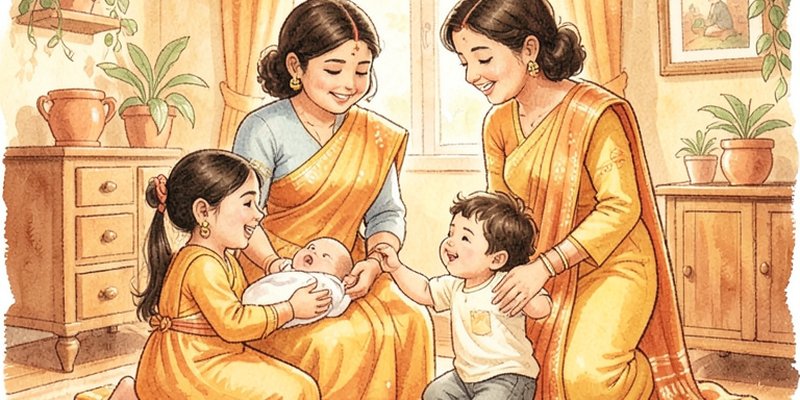
For most of Indian history, parenting was not a two-person job. It was distributed across a household — grandparents, aunts, older cousins, neighbours who were effectively family. That structure did an enormous amount of quiet work, and it did it invisibly, which is why its absence is so hard to name. When a whole generation moved to metros for work, that structure didn't come along. Nothing was built to replace it. The job stayed exactly as large; the number of hands shrank.
So the first thing worth saying plainly: the isolation is structural. You are doing a job designed for many people with far fewer of them. That is not a character flaw. It is a change in how Indian families live, and you are on the wrong side of it through no decision of your own.
To rebuild something, you have to know what it did. The extended household provided three things that are easy to overlook until they're gone.
The first was relief — simply, other hands. Someone to hold the baby while you ate. An adult in the house so that being ill didn't mean the day collapsed. The second was second opinions: another experienced person to say this is normal, mine did the same, it passes. Parenting alone means every small worry has to be carried and resolved by you, without that background hum of other people's experience to steady it.
The third, and the most underrated, was normalisation. In a full household, a hard day with a child was witnessed and absorbed as ordinary. Alone, the same hard day can feel like evidence that something is wrong — with the child, or with you. The village didn't just help with the work. It told you, constantly and without words, that the work was normal.
Naming these three functions is not an academic exercise. It's what lets you rebuild deliberately, because you can only replace what you've defined. "I need more support" is too vague to act on. "I need one person for emergencies, two hours a week that are mine, and one adult to sanity-check my decisions" is a plan.
The instinct, when you need help, is to ask for it. The trouble is that one-way asks are fragile. They accumulate a quiet debt, they feel awkward to repeat, and they tend to dry up exactly when you need them most.
What lasts is reciprocity. An arrangement where their child comes to you on Saturday and yours goes to them on Sunday isn't a favour anyone is keeping score of — it's a structure that benefits both households, which is precisely why it survives. The most robust support networks are built from exchanges, not from generosity.
This is also, honestly, harder than it sounds, and slower. Making parent-friends as an adult is not like making friends at school. It takes repeated, low-stakes contact — the same park, the same class, the same building group — until an acquaintance becomes someone you'd actually call. This will not happen in a fortnight, and any programme that promised to hand you a ready-made village would be lying. What can happen is that you build the first real arrangement, and then the second, and discover that a structure grows from one working relationship rather than from a grand plan for ten.
For most nuclear-family households in a metro, part of the honest answer is paid support. And a startling amount of energy gets spent feeling bad about it.
The guilt has roots worth naming. Many of us were raised to believe that a good parent, and especially a good mother, manages without outside help — that needing it signals some failure of love or capacity. That belief made sense in a household of many hands. It makes no sense at all when you are two people doing the work of eight, and yet it persists, extracting a tax on every rupee spent on help and every hour handed over.
The practical arrangements — finding the right help, structuring the day, deciding what to hand over — are the easy part. The guilt is what keeps people stuck, paying for support they still can't quite let themselves use. Addressing it directly is not a soft add-on. It is often the thing that finally lets a household breathe.
None of this arrives on its own anymore, and that is the whole point. The support that used to come by default now has to be constructed on purpose — one arrangement, one friendship, one honest decision at a time. Done steadily, it adds up to something real: a person to call, a break that actually happens, other adults who tell you the hard days are ordinary.
And behind it sits the largest question, which deserves to be asked out loud: should you move closer to family? For some households it's the right answer, and for others it carries costs that outweigh what it gives. There is no single correct choice here. What there is, is the difference between choosing deliberately — having weighed what proximity would offer and what it would ask — and drifting into an arrangement out of sheer exhaustion. This programme exists so that the choice, whatever it turns out to be, is one you actually made.
Find one family you already half-know — a neighbour, a colleague, a parent from the building. Propose one concrete swap: their child at yours on Saturday morning, yours at theirs on Sunday. A single working exchange is worth more than a hundred good intentions.
Not 'more support' in the abstract. Write the specific gaps: a person for emergencies, two hours a week that are yours, one adult to sanity-check a decision. You cannot build toward a need you haven't named.
That helps in the moment. Changing the pattern takes something else.
Six months on the quiet, specific problem of raising children with no one nearby to share the load — the thing almost every relocated urban family feels and almost no one names.
Before building anything, we get honest about what has been lost. The joint household didn't just supply extra hands — it provided relief, second opinions, and a constant background of normalisation that told you a hard day was ordinary. Naming those functions precisely is what lets you rebuild them deliberately, because you can't replace a thing you haven't defined.
The work of constructing what used to arrive by default. Reciprocal arrangements rather than one-way asks, because the reciprocal ones last and the one-sided ones quietly collapse. How adults actually make parent-friends, which is harder and slower than it sounds. And how to turn loose acquaintance into the kind of relationship you can call at 2am.
For most nuclear-family households, part of the answer is paid help — and a surprising amount of energy goes into feeling bad about that. We work on the practical arrangements and, just as directly, on the guilt attached to needing help you were raised to believe you should manage alone. The guilt is the part that keeps people stuck.
Turning arrangements into habits that survive a busy month, and revisiting the largest questions honestly — whether to move closer to family, what you'd trade for it, and what a good-enough support structure looks like for your particular life. No single answer is right here; the point is to choose deliberately rather than drift.
Small group — deliberately. Few enough that everyone is known, and no one is a spectator.
Message us to hear about dates, structure and fees for the next cohort.
Purnam is an AI-native parenting companion for modern Indian families. A structured programme, a smart companion that knows your family, and a small, honest community of parents — built to take you from surviving the day to thriving across the years.
Parenting that hasn't been handed down — for the generation that wants to parent differently than they were parented, but has no cultural template for it.
Purnam · our positioning
Purnam is built by a founding team with 18+ years across big tech, startups, and growth-stage technology companies — and, more to the point, by parents currently inside the early-childhood years themselves.
Parents to a toddler ourselves — building Purnam to help Indian families move from surviving to thriving.
Purnam's approach draws on modern developmental psychology — attachment, emotional regulation, behavioural coaching — held alongside Indian contemplative traditions as practical tools rather than belief.
We are advised by senior practitioners in human transformation and behavioural coaching. Where the evidence for something is strong, we say so. Where it is contested, we say that too.
Message us on WhatsApp about Parenting Without a Village — dates, structure, fees, and whether it fits your situation.
Or just ask your actual question. That's what the line is for. Someone from the Purnam team will get back to you.
Purnam offers parenting support and education. This is not paediatric, medical, or mental-health treatment, and it is not a substitute for care from a qualified professional. Every child and family is different; nothing here is a promise of any particular outcome.