08:15
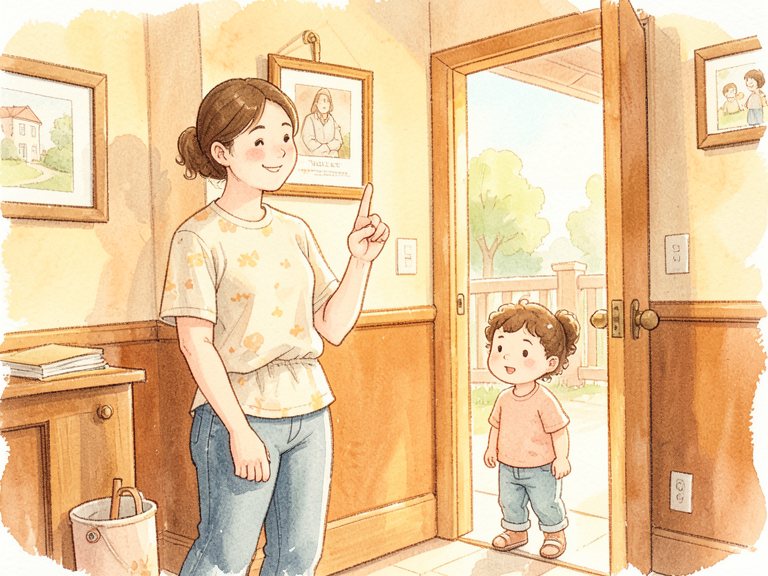
The call runs long, your child is standing in the doorway waiting, and you hold up one finger — again.
Present, Not Perfect ·6 months ·1 – 12 years
Most working-parent guilt isn't a signal that your child is going short. It's the friction between the full-time-parent script you inherited and the dual-career life you actually live. This is slower work — six months on your own relationship to presence, not a weekend of tips. It speaks to fathers as much as mothers.
Guilt is not evidence that you're failing your child. It's usually evidence of a gap between the parenting culture you absorbed and the life you actually live. What children need is predictable, attuned attention — not continuous attention. A reliable twenty minutes does more than a distracted three hours.
Read this first
One thing this programme is not for. There is ordinary working-parent guilt, which is what we work on — and there is something heavier. If what you're carrying is persistent low mood, a flatness that doesn't lift, hopelessness, or the bone-deep exhaustion of burnout rather than everyday guilt, that is not a template problem and it will not yield to rituals. Please speak to a doctor or a mental-health professional, warmly and early. It is the most useful thing you can do for both you and your child, and there is no failure in it.
Six moments from a single ordinary day.
08:15
The call runs long, your child is standing in the doorway waiting, and you hold up one finger — again.

13:00
You miss the school event, again, and spend the afternoon rehearsing the apology you'll make tonight.

20:00
You walk in drained at 8pm and they need you immediately, before you've had a single minute to become a person who can give it.

20:45
The whole weekend becomes an apology — outings, treats, no 'no' — and it ends in a fight anyway.

21:15
Your child turns to the nanny first when they're hurt, and something in your chest drops.

23:30
You lie awake wondering whether quitting your job would actually fix any of this, or just move the ache somewhere else.
Swipe through the day
Start with the feeling, because it is real and it deserves to be taken seriously. The tug when you close the laptop and realise the day is nearly gone. The particular ache of a small face at the door while you mouth one minute. The sense, running quietly under everything, that you are somehow shortchanging the person you would give anything for.
That feeling is genuine. What it is telling you, though, is almost always misread.
Most working-parent guilt is not a signal that your child is going without. It is the friction between two things: the parenting culture you absorbed — often from a mother who was home, in a world with more hands and slower days — and the dual-career life you actually live. You are running one era's software on another era's machine, and the error message that produces is guilt. It feels like a verdict on your love. It is closer to a mismatch of templates.
This distinction is not a comfort trick. It changes what you do next. If the guilt means your child is deprived, the only answer is more hours, which you may not have — and so you drown. If the guilt is a template problem, it becomes something you can actually work with.
Here is the thing worth holding onto, stated plainly: children are shaped less by the sheer quantity of parental attention than by whether the attention they get is predictable and attuned.
Attuned means that when you are with them, you are genuinely with them — reading them, responding to what is actually happening, not managing them with half an eye on a screen. Predictable means they can count on it: this time, most days, is ours. A child does not need you hovering through every waking hour. A child needs to know that reliable, responsive attention exists and will arrive.
This is why the phrase quality time is both true and often unhelpful. It is true that quality outweighs quantity. It is unhelpful because it gets weaponised into a fresh source of guilt — now every shared hour must be magical, enriching, documented. That is not what attunement means. Attunement is mostly ordinary: noticing, listening, being reachable. A dependable twenty minutes of that does more for a child than three distracted hours in which you are physically present and emotionally elsewhere, which children read instantly and which teaches them that your body being in the room is not the same as you being available.
Continuous attention, in fact, is neither possible nor good for a child. Some of the most important learning of childhood happens in the unattended stretches — the boredom, the self-directed play, the small negotiations with other people. The goal was never to be present every moment. It was to be present, reliably, in some.
So you compensate. Monday to Friday you feel the deficit accumulate, and by Saturday you are ready to repay it — the outings, the treats, the yeses to everything, a whole weekend engineered as an apology.
It rarely lands the way you hope, and it often ends in tears. There are reasons.
A child cannot draw down a debt of attention in a single overloaded burst; presence doesn't work like a bank. What the packed weekend usually produces is overstimulation and dropped limits, and children do not feel more secure when the rules dissolve — they feel less. The very structure that makes them feel held goes soft precisely when you are trying hardest. And the guilt underneath tends to leak: a weekend run on guilt is tense, over-eager, quick to disappointment when the child doesn't perform the gratitude you were unconsciously hoping to buy. The fight at the end is not a failure of effort. It is the predictable result of trying to make two days heal a feeling that two days were never the cause of.
Steadiness across the ordinary week does more than any grand Saturday. Children are reassured by rhythm, not by spectacle.
All of this is harder here, and it helps to say why rather than pretend the pressure is imaginary.
The template most Indian parents inherited assumes a village — grandparents down the corridor, extended family, a slower economy of time and hands. The nuclear, dual-career, big-city household has kept the template's expectations and lost its infrastructure. You are being measured against a standard of constant maternal presence that was only ever possible because a dozen other people were absorbing the load, and now they are not.
Layered on top is an intensive-parenting culture that has arrived at full strength — the sense that a good parent is optimising every hour, and that any gap is a gap you will answer for. And then there is the commentary, which any working mother in India can recite from memory: the questions about who is really raising the child, the raised eyebrow at the working late, the assumption that a father's involvement is a bonus and a mother's absence a wound. Fathers carry this too, and often have nowhere to put it — but the social scrutiny falls hardest and most publicly on working mothers, and pretending otherwise would be dishonest.
Some of what you feel, in other words, is not yours. It was handed to you. Part of this work is learning to tell the difference between the standards you actually hold and the ones you have simply been made to carry.
Which brings us to the reframe the whole programme turns on.
You have been treating presence as a question of virtue — as though the ache means you are not loving enough, not sacrificing enough, not there enough. Framed that way, there is no solution, only penance. But presence, for a working parent, is far better understood as a design problem. Given the actual hours you have, the actual energy you arrive home with, the actual shape of your week — how do you build reliable, attuned contact into it? What small rituals will survive a bad Tuesday? What is the crossing that lets you arrive as a parent rather than a person still half inside a meeting?
These are questions with real answers, and they have nothing to do with whether you are a good parent, which you already are. Over six months we do this work slowly, because it is not a technique to install but a relationship to your own life to rebuild — and that does not happen in a weekend. The guilt may not vanish entirely; some of it is just love with nowhere to go. But it can stop running the show. And you can come to hold your working life not as a debt you are forever repaying, but as one honest, ordinary way to raise a child well.
Not the whole evening — twenty minutes, phone in another room, nothing else running. Same slot most days if you can. Attention your child can predict does more than attention that arrives in unpredictable, guilty floods.
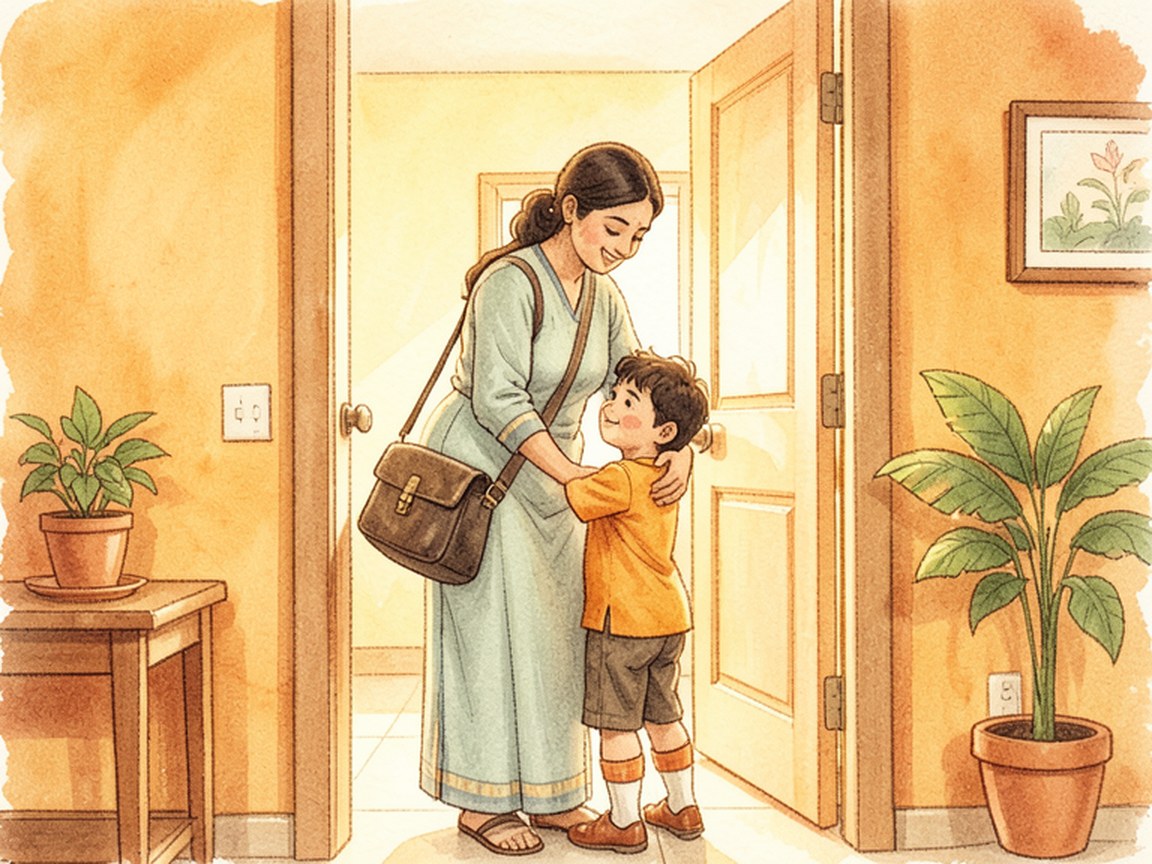
You cannot walk out of a work-self and into a parent-self at the doorway; nobody can. Give yourself a small, deliberate crossing — two minutes in the car, a change of clothes, one slow breath before the door — so you arrive as the parent rather than the person who was just on the call.
In words they can hold: 'I work in the day, and this time in the evening is ours.' Naming the shape of the day, in an age-appropriate way, does more for a child than a guilty over-explanation ever will.
That helps in the moment. Changing the pattern takes something else.
Six months on the guilt itself — where it comes from, why it doesn't move when your schedule does, and how to build a way of being present that survives a hard week. This is identity work, done slowly, not a course you finish and forget.
Before changing anything, we trace the guilt to its source — usually a full-time-parent template absorbed from your own childhood, applied to a life that looks nothing like the one it was written for. Naming the template is what loosens its grip; you cannot argue with a standard you can't see.
An honest, unsentimental picture of where your time actually goes, and where your attention goes inside that time. Most parents discover the problem isn't the number of hours but how fractured and distracted those hours are — which is a far more workable problem than the one they thought they had.
Not aspirational routines that collapse the first hard Tuesday, but two or three small, durable anchors built to hold when you're exhausted, travelling, or short. We design them around your real constraints, then stress-test them against the weeks that usually break everything.
The slow part: coming to hold your working life as a legitimate way to raise a child rather than a compromise you're perpetually apologising for. We work on interrupting the guilt spiral, on what you want your child to absorb about work and love, and on a version of presence you can actually sustain.
Small group — deliberately. Few enough that everyone is known, and no one is a spectator.
Message us to hear about dates, structure and fees for the next cohort.
Purnam is an AI-native parenting companion for modern Indian families. A structured programme, a smart companion that knows your family, and a small, honest community of parents — built to take you from surviving the day to thriving across the years.
Parenting that hasn't been handed down — for the generation that wants to parent differently than they were parented, but has no cultural template for it.
Purnam · our positioning
Purnam is built by a founding team with 18+ years across big tech, startups, and growth-stage technology companies — and, more to the point, by parents currently inside the early-childhood years themselves.
Parents to a toddler ourselves — building Purnam to help Indian families move from surviving to thriving.
Purnam's approach draws on modern developmental psychology — attachment, emotional regulation, behavioural coaching — held alongside Indian contemplative traditions as practical tools rather than belief.
We are advised by senior practitioners in human transformation and behavioural coaching. Where the evidence for something is strong, we say so. Where it is contested, we say that too.
Message us on WhatsApp about Present, Not Perfect — dates, structure, fees, and whether it fits your situation.
Or just ask your actual question. That's what the line is for. Someone from the Purnam team will get back to you.
Purnam offers parenting support and education. This is not paediatric, medical, or mental-health treatment, and it is not a substitute for care from a qualified professional. Every child and family is different; nothing here is a promise of any particular outcome.