
Monday
You say no, and then cave after twenty minutes of protest — and you can feel your child learning that protest works.
Boundaries That Hold ·3 months ·2 – 10 years
If you're caught between the strictness you were raised with and the gentleness you've been reading about — landing nowhere, then feeling guilty about it — this programme is about holding fewer boundaries, more calmly, and actually being able to keep them.

A boundary is something you do, not something you make your child do — which is why boundaries held calmly work when threats don't. The parents who struggle least usually hold fewer boundaries more consistently, rather than many boundaries inconsistently. The skill is less about finding the right words in the moment and more about deciding, in advance, what you will actually do.
Read this first
A word about physical discipline, said plainly. Many parents reading this were raised with a slap or a cane, and some are still using it — usually not out of cruelty but because it is the only tool that was ever handed to them, and because in the moment nothing else seems to work. If that is you, you are not being judged here. But hitting is not a boundary; it is what happens when a parent has run out of them, and it teaches fear rather than cooperation. The whole of this programme is about giving you the other tools, so that the moment you'd normally reach for that one has something better in it. If you find you cannot stop, that is worth speaking to a qualified professional about — not as a failing, but as a thing that deserves real help.
One ordinary week in your house.
Monday
You say no, and then cave after twenty minutes of protest — and you can feel your child learning that protest works.

Tuesday
You threaten a consequence you would never actually carry out, and you both know it.

Wednesday
You swing between too strict and too soft in a single evening, depending on how tired you are.
Thursday
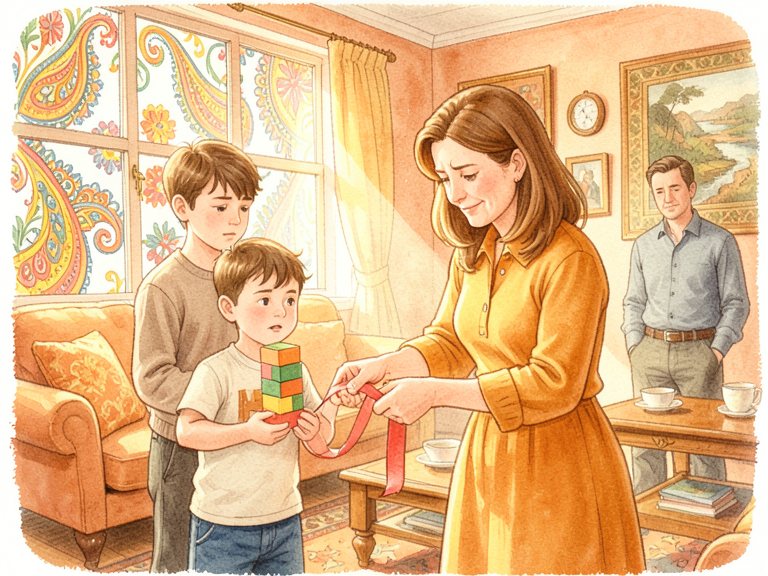
You hold a line, and another adult in the house quietly undoes it.

Friday
You genuinely don't know where the line should even be — what's reasonable to expect at this age?

Saturday
One relative calls you strict; another calls you soft. You've stopped trusting your own read.
Swipe through the day
There is a particular exhaustion that comes from being caught between two models of parenting and belonging to neither.
On one side is the way you were raised: firm, often loud, obedience-first, a world where a raised voice or a raised hand settled most questions and "respect" mostly meant silence. On the other is everything you've read since — gentle, patient, full of feelings named and validated, written as though your household contained exactly two adults and no grandparents at all.
So you improvise. You try the gentle way, it feels like it isn't working, you snap back to strictness, you feel guilty about the snap, and you over-correct into softness again. By evening you've been both parents in a single day. Your child, sensibly, has learned that the rules depend on your mood, and has started reading your mood the way a sailor reads weather.
This programme is for that exact position. Not the strictness you came from, not the imported gentleness that assumes a home you don't live in — a third thing, built for an Indian household, that is both firmer and calmer than either.
Here is the sentence that changes the most: a boundary is something you do, not something you make your child do.
Most parents think of a boundary as a rule imposed on the child — no more sweets, stop hitting your brother, get off the tablet. Framed that way, every boundary depends on the child's cooperation to exist, which means every boundary is really a request, and a request can be refused. That refusal is what parents experience as their child "having no respect for rules." But the child isn't disrespecting a rule. They're declining a request, which is a thing requests invite.
Now hold the same limits as your own actions. Not "stop watching" but "I turn the television off." Not "no more sweets" but "I'm not buying them today." Not "get off the tablet" but "the tablet goes back in the drawer at seven, and I'm the one who puts it there." These don't require your child's agreement to happen. They happen because you do them. That is the whole shift, and it sounds small until you feel the difference between a limit you can enforce alone and one you're constantly negotiating.
This will not end tantrums, and any programme that promised to would be lying. Your child will still be furious that the tablet went away. What changes is that their fury no longer decides whether the boundary holds — because the boundary was never in their hands to begin with.
Most homes run on threats, and most of those threats are never carried out.
"If you do that again, no screens for a week." "One more time and we're going straight home." "I'll give this away to another child." You say them because in the moment they're the fastest thing available, and often they work once. The trouble is what they teach across the hundredth time. A child is an excellent scientist. Every threat you don't enforce is a data point, and the conclusion the data supports is that limits are negotiable — that "no" is an opening bid, and enough protest reopens it.
This is why the twenty-minute cave is so damaging, and so common. It isn't the caving in itself; it's that you've just run an experiment proving that twenty minutes of protest changes the outcome. You've trained precisely the behaviour you were trying to stop, and trained it more effectively than any deliberate lesson could.
The way out is not to make bigger threats or to finally follow through on the impossible ones. It's to stop making threats you won't keep, and to replace them with the small number of actions you actually will. A boundary you'll hold every time, even a modest one, teaches more than a dramatic one you enforce one time in five.
Parents new to this often expect it to mean more control. It usually means less — fewer rules, more consistently held.
A home with thirty rules holds almost none of them, because no adult can track thirty limits through a real day, and the child quickly learns that most of them are decorative. A home with three real boundaries can hold all three, every time, and it is the every-time that does the work. Predictability is what a child settles into. Unpredictability is what they probe. Three boundaries held without exception produce a calmer home than thirty held at random, and they cost the parents far less.
Choosing the three is harder than it sounds, which is why we give it a whole phase. It forces you to decide what actually matters versus what you've simply inherited as a rule — and to size your expectations to the child in front of you rather than the child you have in mind. A great deal of what looks like defiance is a three-year-old being asked to hold what a seven-year-old could, and no amount of firmness fixes a limit that was wrong for the age.
Then comes the part that breaks most Indian households: the second adult. You can hold your three boundaries with perfect calm and consistency, and a grandparent, a spouse, or a caregiver can undo all of it in a moment, in front of the child, with the best of intentions. The audience effect in a joint home makes this worse — a child performs differently, and an elder responds differently, when the whole family is watching. This isn't solved by winning an argument. It's solved by reaching an agreement between the adults, out of the child's earshot, and by learning to handle the override in the moment without turning the living room into a battlefield. It is the hardest skill in the programme and, in most Indian homes, the one that actually decides whether any of the rest holds.
By the end you won't have a way to switch off a tantrum on demand — no one can hand you that, and the promise itself is the tell of a bad programme. What you'll have is a change in what you're able to do.
You'll hold a limit through your child's upset without either giving way or hardening into the parent you didn't want to be. You'll have stopped making threats you won't keep, which alone quiets a home more than any technique. You'll know, for yourself, the difference between a consequence and a punishment, and you'll be able to be firm without reaching for fear. And you'll have language for the moment another adult undoes your line — the one situation that undoes more parents than any tantrum ever has.
None of it requires becoming stricter, and none of it requires becoming a pushover. It requires holding a small number of things, calmly, every time, together. That is what a boundary that holds is actually made of.
Pick a threat you keep making and never enforcing — 'no screens for a week', 'we're going home right now'. Replace it with something that depends only on you: 'the tablet goes back in the drawer, I'll keep it there.' A boundary you can carry out alone is worth ten you need your child's cooperation to enforce.
Write down the three limits that genuinely matter to you — safety, usually, and one or two others. Everything outside those three, let go of for now. Most homes are exhausting because everything is a rule; almost nothing then gets held.
The next time your child is upset that you've said no, try holding both at once: the limit stays ('we're not buying it today') and the feeling is allowed ('you're really disappointed, I know'). You are not required to remove the upset to have held the boundary well.
That helps in the moment. Changing the pattern takes something else.
Three months on the small number of limits that genuinely matter in your home, and on the far harder question of how to hold them — calmly, consistently, and across every adult in the house.
We start by separating two things that usually get tangled: a boundary, which is your own action, and a demand for compliance, which is a request that your child behave a certain way. Most of the frustration parents carry comes from trying to control the second when they only ever had power over the first. We look at why threats you won't enforce quietly teach that limits are negotiable, and at the difference between a consequence and a punishment — which turns out to be about the relationship, not the severity.
Fewer, firmer boundaries beat many soft ones, and this is the phase where you decide which few. We work through your actual home — the flashpoints, the daily negotiations, what's worth a stand and what isn't. This includes honest work on age-appropriate expectations: what a three-year-old can genuinely hold is not what a nine-year-old can, and a great deal of conflict comes from asking for the wrong thing rather than asking wrongly.
A boundary is easy to state and hard to hold, and the hard part is almost always your child's distress about it. This phase is the craft of holding a limit while allowing the feeling — staying steady through the protest without either caving or hardening. We work on what to do in your own body when the crying starts, because that, far more than the words, is what determines whether the limit survives the evening.
This is where most Indian households actually break — not on the boundary itself but on the second adult who undoes it. We work directly on alignment across parents, grandparents and caregivers: how to reach agreement between the adults rather than issuing rules to each other, how to handle the relative who overrides you in front of the child, and how to keep a shared line without turning the home into a battlefield over it.
Small group — deliberately. Few enough that everyone is known, and no one is a spectator.
Message us to hear about dates, structure and fees for the next cohort.
Purnam is an AI-native parenting companion for modern Indian families. A structured programme, a smart companion that knows your family, and a small, honest community of parents — built to take you from surviving the day to thriving across the years.
Parenting that hasn't been handed down — for the generation that wants to parent differently than they were parented, but has no cultural template for it.
Purnam · our positioning
Purnam is built by a founding team with 18+ years across big tech, startups, and growth-stage technology companies — and, more to the point, by parents currently inside the early-childhood years themselves.
Parents to a toddler ourselves — building Purnam to help Indian families move from surviving to thriving.
Purnam's approach draws on modern developmental psychology — attachment, emotional regulation, behavioural coaching — held alongside Indian contemplative traditions as practical tools rather than belief.
We are advised by senior practitioners in human transformation and behavioural coaching. Where the evidence for something is strong, we say so. Where it is contested, we say that too.
Message us on WhatsApp about Boundaries That Hold — dates, structure, fees, and whether it fits your situation.
Or just ask your actual question. That's what the line is for. Someone from the Purnam team will get back to you.
Purnam offers parenting support and education. This is not paediatric, medical, or mental-health treatment, and it is not a substitute for care from a qualified professional. Every child and family is different; nothing here is a promise of any particular outcome.