Minute 0
A dropped biscuit or the wrong colour cup, and an hour disappears into it.
Big Feelings ·6 months ·3 – 12 years
The same small disappointment that produces a shrug in one child produces a forty-minute collapse in another. This is temperament, not indulgence or failure — and it responds to being contained, not corrected.
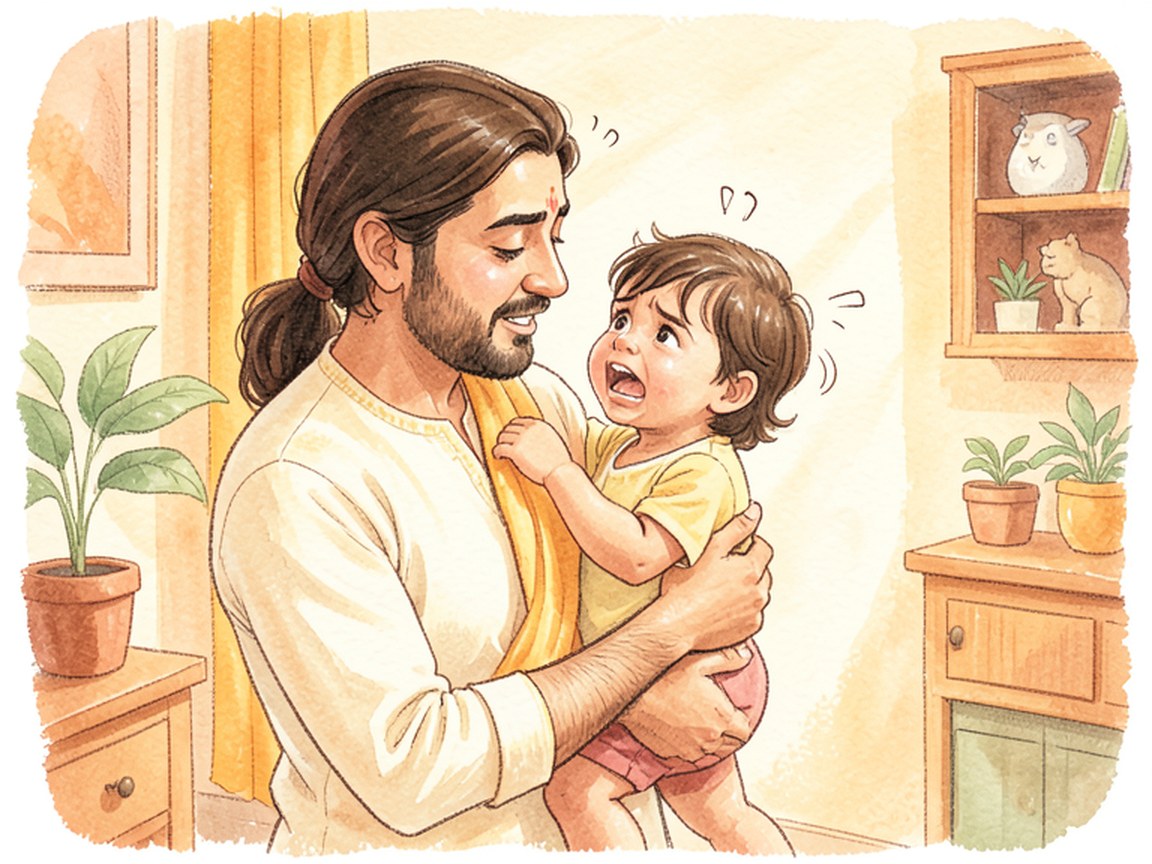
Some children experience emotion at higher volume than others — the same disappointment that produces a shrug in one child produces a forty-minute collapse in another. This is temperament, not indulgence or a parenting failure, and it asks for containment rather than correction: staying steady and present while the wave passes, instead of trying to reason it down mid-wave.
Read this first
Temperament and diagnosis are different questions. If you are wondering whether what you're seeing is anxiety, autism, ADHD or sensory processing difficulty rather than temperament, that is a real and important question — and it is not one a parenting programme can answer. Please see a child psychologist or developmental paediatrician who can assess your child properly. A good assessment doesn't replace this work; it tells you whether this is the right work. When in any doubt, start there.
How one of these actually unfolds.
Minute 0
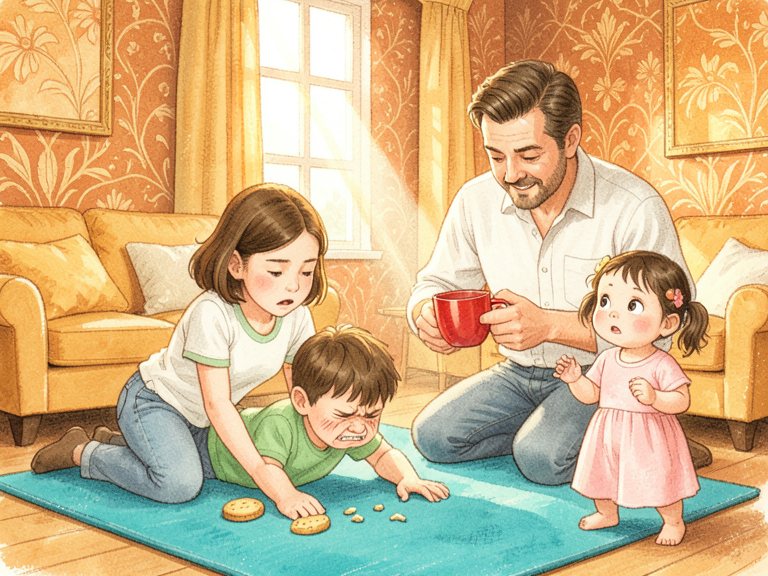
A dropped biscuit or the wrong colour cup, and an hour disappears into it.
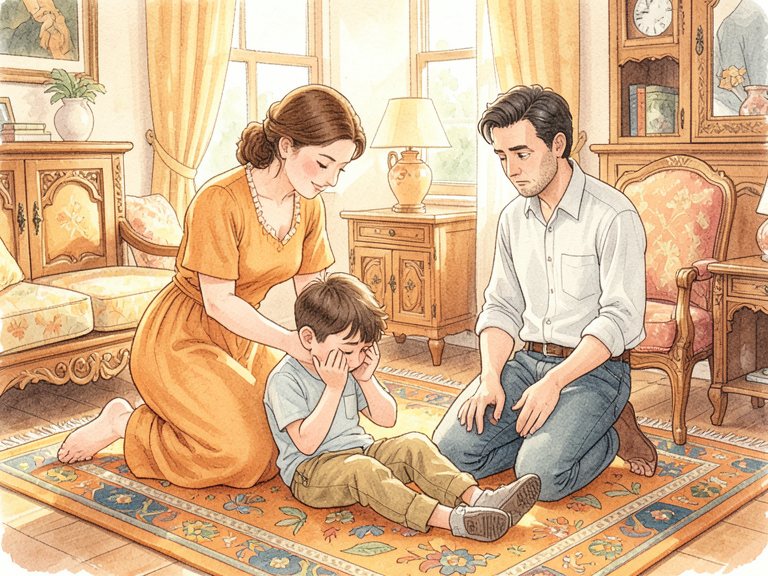
Minute 2
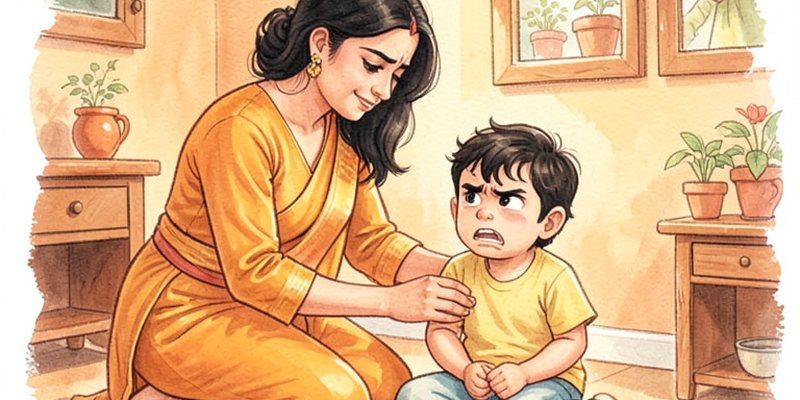
The shame spiral — "I'm the worst, everybody hates me, I ruin everything" — over something small.

Minute 5
Weddings, malls, birthday parties: the noise and crowd build until your child comes apart.

Minute 9
A relative tells you, in front of everyone, that you've spoilt them and made them soft.
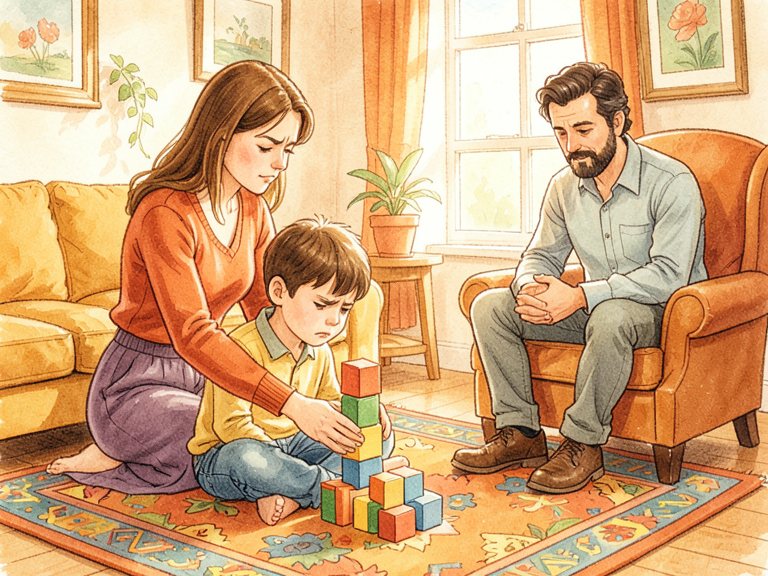
After
Every technique that works on other children seems to make yours worse.
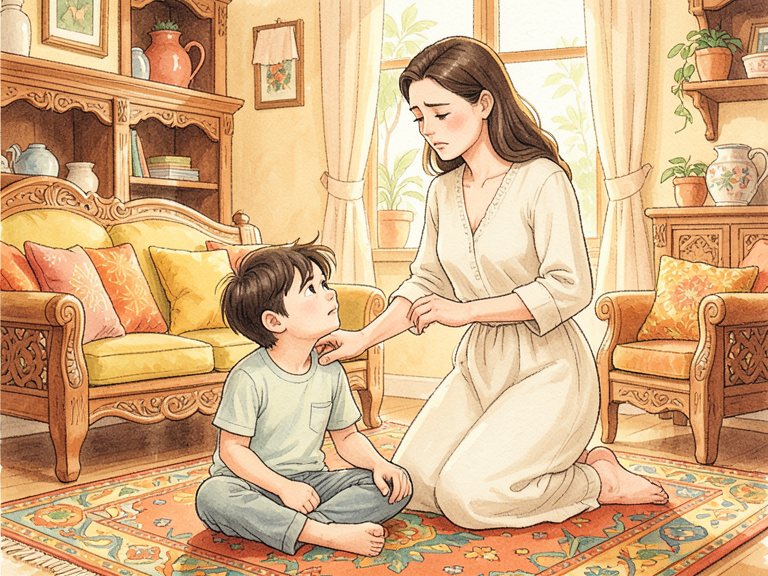
Later
Your own nerves fraying by evening, because holding this intensity all day has a cost you rarely name.
Swipe through the day
There is a particular kind of tiredness that belongs to the parent of an intense child, and it is hard to describe to anyone who hasn't lived it. It isn't the tiredness of a hard day. It's the tiredness of having spent that day holding something large — of having absorbed wave after wave of feeling that arrived at a volume other people simply don't experience.
Because that is the thing to understand first. Some children feel everything more loudly. The disappointment of a cancelled outing, the injustice of a sibling getting the bigger slice, the wrongness of a sock with a seam in the wrong place — these land in an intense child the way a genuine crisis lands in the rest of us. The feeling is not exaggerated. It is real, and it is that big, and it fills the whole room and the whole hour.
This is temperament. It is a stable feature of how a child is wired, present early and recognisable across situations, and it is neither a phase they are choosing to stay in nor a fault line you opened by being too soft. You did not create it and you cannot correct it away. What you can do is change how you meet it — and that turns out to make a very large difference.
It helps to be honest about the cost and the feature together. The same wiring that makes these children feel disappointment at full volume tends to make them feel delight at full volume too. They often notice more, care more, and register the emotional weather of a room faster than the adults in it. The intensity is not a defect with a silver lining. It is a single trait that shows up as both the forty-minute collapse and the fierce, wholehearted love. You don't get to keep one and return the other.
Most parents of intense children arrive having tried, over and over, to talk the child down. It's the obvious move: the feeling seems out of proportion, so you explain the proportion. It's just a biscuit. There will be another party. Your sister didn't mean it. And it doesn't work — often it makes things worse — and after enough repetitions you start to feel that either the child is being manipulative or you are failing.
Neither is true. The reason reasoning fails mid-wave is that the part of the brain you're appealing to has, for the moment, gone offline. A child in the full flood of a big feeling is not available for logic, negotiation or perspective. Talking harder into that state is like reasoning with someone who is underwater — not because they won't listen, but because they can't, yet.
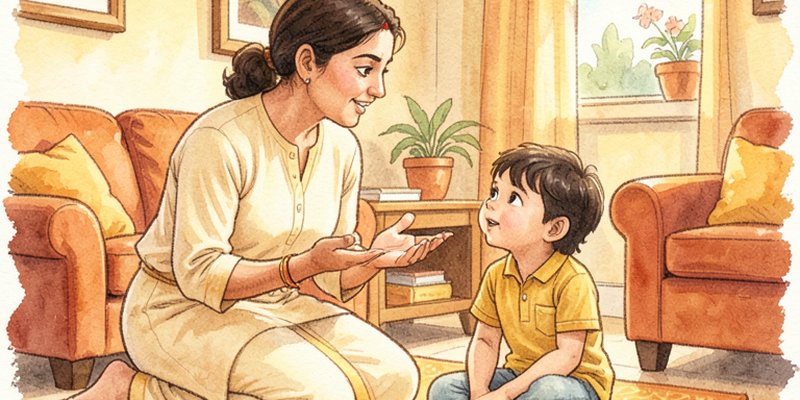
What an intense child needs in that moment is not an argument. It is an anchor. Someone steady, close and unbothered by the size of the storm, who conveys through their own calm that the feeling is survivable and that the adult in the room is not frightened by it. This is what containment means, and it is the single most important skill in this programme. Your regulation is the intervention. The child, in effect, borrows your steadiness until their own comes back online — and then, once the wave has passed, there is a child you can actually talk to.
This is worth saying plainly: this will not end the meltdowns, and any programme that promised to would be lying. Intense children have intense feelings; that is what the word means. What changes is how those feelings are met, how long they last, and what your child slowly learns about carrying them — which is a great deal, but it is not the same as a switch that turns the intensity off.
There is a cruelty built into intensity, and it's worth naming directly.
An intense child in the middle of a shame spiral — "I'm the worst, everybody hates me, I ruin everything" — is, in that moment, about as unappealing to connect with as a child gets. They may push you away, say something wounding, reject the very comfort they need. Every instinct you have says to step back, to let them cool down, to not reward the behaviour with attention.
And this is exactly the moment they need you closest. The shame spiral is not manipulation; it is a small person whose feeling has curdled into a verdict about themselves, and who cannot climb out alone. Stepping back confirms the verdict. Staying — steady, warm, unhurried, not arguing with the content but present through it — is what interrupts it. You are not agreeing that they are the worst. You are demonstrating, by not leaving, that they are not.
None of this is intuitive, and none of it is what most of us were raised with. It asks you to move toward a child at precisely the moment your training says to withdraw. That's why it takes practice, and why it takes support — it runs against the grain of the reflex.
Almost everything about Indian family life is louder, more crowded and more sensory than the environments most parenting advice quietly assumes. The wedding that runs past midnight. The joint-family lunch with fifteen people and three conversations at once. The mall on a Sunday, the firecrackers, the temple crowd, the long train journey. For an intense, sensory-alert child, these are not neutral backdrops. They are a rising tide, and the meltdown at the end of the function is usually the accumulated overwhelm of the whole day finally arriving.
Then there is the commentary. Few parents of intense children in India are allowed to figure this out in peace. There is nearly always a relative ready to diagnose the problem as your softness — you've spoilt him, in our time a slap sorted this out, you're making him weak. This lands hardest on boys, because our culture reads sensitivity in a boy as something to be trained out rather than understood, and it lands in front of an audience, which makes holding your line so much harder.
And the school system, for the most part, has a low tolerance for a child who feels things at this volume. The intense child is easily read as the difficult one, the crybaby, the disruptive one — labels that can stick to a child's own sense of themselves long before anyone asks whether they might simply be built to feel more.
This programme takes all of that as the actual terrain, not a footnote. We work on the pre-event plans that make functions survivable, on the specific words for the uncle who thinks you're ruining the child, and on protecting your child from a cultural reading of their temperament as weakness. None of this is available in advice written for a quieter, more private, less crowded kind of childhood.
It's worth being clear about what six months of this work does and doesn't do, because the honest version is more useful than the hopeful one.
What doesn't change is the temperament. Your child will still feel things more than other children. The wiring is the wiring. If your hope is a calmer, quieter, less intense child, no programme can honestly promise it, and you should be wary of any that does.
What changes is you, and then, slowly, what your child learns from you. You gain a way to tell a temperament wave apart from a behaviour that needs a boundary — a distinction that quietly removes a great deal of unnecessary conflict. You gain a containment response you can actually hold, so the waves have somewhere steady to break. You gain a plan for the environments that reliably undo your child, so the wedding stops being an inevitable disaster. You gain language for the shame spiral and for the relatives. And you gain a way of protecting your own reserves, so that you can keep doing this for years rather than burning out in weeks.
Over time, held this way, an intense child usually does build real skill at carrying their own big feelings — not because the feelings shrank, but because they learned, from a steady adult who kept showing up, that a feeling that large can be survived. That is the work. It is slower and quieter than a fix, and it is worth far more.
In the middle of a big wave, resist the urge to solve, explain or talk them down. Sit close, stay quiet, keep your own face and voice calm. You are not fixing the feeling — you are being the steady thing it can break against until it passes.
For the events you already know will overwhelm — the function, the mall, the long lunch — decide in advance where the quiet exit is, how long you'll actually stay, and one signal your child can give you when it's becoming too much. Prevention travels further than management.
One sentence: "That felt really big." Not "it's not a big deal," not "stop crying." Naming the size of a feeling without arguing with it tells your child the feeling is allowed to exist — which is often what lets it start to shrink.
That helps in the moment. Changing the pattern takes something else.
Six months on the child who feels everything more loudly than the people around them — and on the steadiness that turns out to be the actual intervention.
We start by getting clear on what you're dealing with. Emotional intensity is a real, stable feature of how some children are wired — not a phase they're being difficult in, and not something you caused by being gentle. We map your child's specific pattern: what sets the wave off, how long it runs, and what it costs both of you. Most parents leave this first stretch with a name for something they'd been told was simply misbehaviour.
The core skill, given room to actually take hold. Containment means your steadiness becomes the intervention — you stay regulated while your child is not, and that is what the nervous system borrows from. Then the harder cousin: the shame spiral, where a small feeling collapses into "I'm the worst." We work on catching it early and on the language that interrupts it without either dismissing it or feeding it.
This is where the India layer lives. Loud, crowded, sensory-heavy family functions; the long joint-family lunch; the mall on a Sunday. We build pre-event plans, exit routes and recovery time, and we work on the commentary — the relative who calls your child spoilt, or soft, and how to hold your line without a scene. Special attention to how sensitivity is read in boys, and how to protect your child from that reading.
Parenting an intense child is intense. Holding steady all day, absorbing waves without adding your own, is real work, and running on empty is the fastest route back to correction and shouting. This final stretch is about your own regulation, your recovery, and building a way of doing this that you can sustain for years rather than weeks.
Small group — deliberately. Few enough that everyone is known, and no one is a spectator.
Message us to hear about dates, structure and fees for the next cohort.
Purnam is an AI-native parenting companion for modern Indian families. A structured programme, a smart companion that knows your family, and a small, honest community of parents — built to take you from surviving the day to thriving across the years.
Parenting that hasn't been handed down — for the generation that wants to parent differently than they were parented, but has no cultural template for it.
Purnam · our positioning
Purnam is built by a founding team with 18+ years across big tech, startups, and growth-stage technology companies — and, more to the point, by parents currently inside the early-childhood years themselves.
Parents to a toddler ourselves — building Purnam to help Indian families move from surviving to thriving.
Purnam's approach draws on modern developmental psychology — attachment, emotional regulation, behavioural coaching — held alongside Indian contemplative traditions as practical tools rather than belief.
We are advised by senior practitioners in human transformation and behavioural coaching. Where the evidence for something is strong, we say so. Where it is contested, we say that too.
Message us on WhatsApp about Big Feelings — dates, structure, fees, and whether it fits your situation.
Or just ask your actual question. That's what the line is for. Someone from the Purnam team will get back to you.
Purnam offers parenting support and education. This is not paediatric, medical, or mental-health treatment, and it is not a substitute for care from a qualified professional. Every child and family is different; nothing here is a promise of any particular outcome.